

If you are currently sourcing through perfume bottle wholesale channels, here is a data point that should stop you cold: according to market sampling analysis across major B2B platforms, more than 80% of listings labeled “crystal perfume bottles” do not contain natural crystal at all. They are made from fused glass — a material that is fundamentally different in composition, chemical stability, and perceived value. Yet the product titles, the marketing copy, and the price points all tell a different story. This disconnect is not an accident. It is a structural problem baked into how the crystal perfume bottle wholesale supply chain operates today.
What does this mean for your brand? It means that if you have not verified your supplier’s material claims, there is a statistically strong chance your “crystal” packaging is eroding the premium positioning you paid to build. This article breaks down eight risk categories — ranked by business impact — that every serious buyer must understand before committing to a wholesale order. Whether you are a fragrance startup placing your first 500-unit trial run or a scaling brand negotiating a 10,000-piece contract, the risks described below apply directly to your bottom line.
- Risk #1: Material Fraud — The "Crystal" Label That Means Almost Nothing
- Risk #2: The Sample-to-Bulk Gap — Why Your Approved Sample Is Not a Production Guarantee
- Risk #3: The True Cost of Perfume Bottle Wholesale Is Never the Unit Price
- Risk #4: Seal Failure and Structural Mismatch — The Defect That Generates the Most Customer Complaints
- Risk #5: Transit Fragility — Why Shipping Natural Crystal Demands a Fundamentally Different Logistics Strategy
- Risk #6: MOQ Pressure and Inventory Traps — The Cash Flow Risk That Kills New Fragrance Brands Before Launch
- Risk #7: Lead Time Volatility — How an Unstable Production Schedule Destroys Your Market Timing
- Risk #8: The Low-Price Supplier Trap — Why the Cheapest Perfume Bottle Manufacturer Is Your Most Expensive Option
- A Risk-Aware Procurement Framework for Serious Fragrance Brands
- Crystal Perfume Bottle Wholesale Risks Faqs
Risk #1: Material Fraud — The “Crystal” Label That Means Almost Nothing
The Fused Glass Problem Hiding in Plain Sight
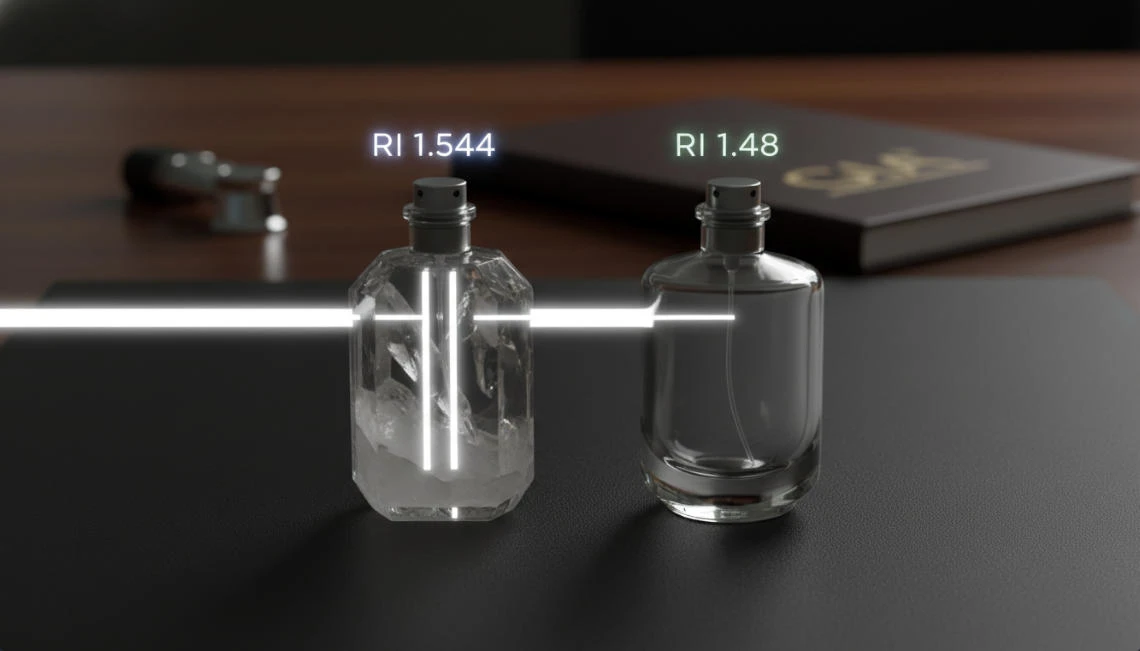
When buyers search for crystal perfume bottle wholesale options online, they are typically shown hundreds of listings using the word “crystal” as a marketing term rather than a material descriptor. The industry distinction is critical: natural crystal — such as quartz, amethyst, or jade — is a mineral formed through geological processes over millions of years, with a specific refractive index, hardness rating, and chemical composition. Fused glass, sometimes called “reconstituted crystal” or “crystal glass,” is manufactured by melting silica with additives like lead oxide or barium oxide. According to the Gemological Institute of America (GIA), natural gemstone materials carry verifiable physical properties that synthetic or glass alternatives simply cannot replicate — and those differences are measurable.
The practical consequence for your brand is direct and painful. You position your fragrance as a luxury product. Your customer receives a bottle that, under close inspection or through a basic refractometer test, reads as glass. The perceived value gap between natural crystal and fused glass is significant — market pricing data suggests that natural crystal commands a 30–50% premium in retail contexts precisely because of its rarity, weight, and optical clarity. When that distinction is absent from the actual product, you are not just losing authenticity — you are actively misleading the consumer who paid for something they did not receive.
The Chemical Stability Risk You Are Probably Not Pricing In
Material fraud at the high end — where premium glass is passed off as natural crystal — primarily damages your brand’s positioning. But there is a second, more dangerous version of this problem. Certain low-cost suppliers use substandard glass formulations that contain impurities or unstable compounds. When these materials come into prolonged contact with the chemical compounds in perfume formulations — specifically ethanol concentrations above 70%, essential oil blends, and synthetic colorants — reactions can occur that produce visible cloudiness, discoloration, or sediment inside the bottle.
This is not a minor aesthetic issue. A customer who opens a bottle of perfume and finds it visually altered will not just return the product — they will document it, post it, and share it. According to the International Gem Society (IGS), the chemical inertness of a material is one of its defining quality characteristics for contact applications. You can verify chemical compatibility through third-party material testing, which any credible perfume bottle manufacturer should be able to provide upon request. This means you can protect your product formulation and your customer relationship simultaneously by requiring documentation before, not after, your order ships.
How to Verify Material Authenticity Before You Commit
Before placing any perfume bottle wholesale order that claims natural crystal content, you need to demand three things: a third-party material composition report from a recognized testing body, a physical sample that you can independently test for refractive index and density, and a written material specification sheet that becomes part of your purchase contract. Natural quartz, for example, has a refractive index of approximately 1.544–1.553 and a Mohs hardness of 7 — both figures are measurable with standard gemological tools. SSEF Swiss Gemmological Institute provides internationally recognized authentication services that can serve as a credible reference standard in your supplier negotiations. This means you are not asking a supplier to self-certify — you are establishing an objective benchmark that eliminates ambiguity from the relationship entirely.
Risk #2: The Sample-to-Bulk Gap — Why Your Approved Sample Is Not a Production Guarantee
The Economics Behind Why Suppliers Over-Deliver on Samples
There is a commercial logic that most buyers never see, and it works against you every time. When a perfume bottle manufacturer is competing for your order, the sample is their sales pitch — a physical argument for why you should choose them over five other suppliers sending you identical-looking boxes. The economics of that moment are straightforward: the supplier’s cost to produce one or five exceptional samples is negligible relative to the value of your purchase order. So they will hand-finish the engraving. They will hand-select the clearest stone. They will spend forty minutes on a cap fit that, in production, gets thirty seconds of attention. The result is a sample that genuinely impresses — and a bulk order that does not match it.
This is not speculation. It is a structural reality of how contract manufacturing operates across the perfume bottle factory ecosystem in China, India, and Southeast Asia. The craftsperson who carved your sample prototype is not the same person — or the same process — that produces your 2,000-unit run. Production line logic prioritizes throughput over perfection. That trade-off is invisible during sampling and becomes visible at the worst possible moment: when your inventory arrives and your launch timeline has no room for renegotiation.
The Three Most Common Bulk Deviation Failures
Understanding where deviations typically appear gives you the leverage to prevent them. The first and most frequent failure point is surface finish consistency. Hand-polished facets that catch light beautifully in a sample often become machine-polished in bulk — resulting in slightly different light refraction, less depth of clarity, and a visual character that reads as cheaper even if you cannot immediately identify why. The second common failure is engraving depth and detail. Custom logos, floral patterns, and geometric cuts that appear crisp at 0.5mm depth in the sample may be executed at 0.3mm in production due to tool wear, speed settings, or operator variability. The third failure is color or material batch inconsistency — particularly relevant for semi-precious stones like rose quartz or amethyst, where natural color variation between mining batches can produce a noticeably different visual tone across your order.
According to quality control benchmarks published by the China Inspection and Testing Alliance, batch deviation rates in artisan-adjacent manufacturing categories can reach 12–18% without formal first-article inspection protocols in place. That figure translates directly into customer-facing inconsistency, return processing costs, and brand perception damage that no price negotiation ever accounts for in advance. This means that your approval of a sample, without contractual safeguards, is a handshake agreement built on a production reality you have not yet seen.
Three Contractual Mechanisms That Close the Sample-to-Bulk Gap
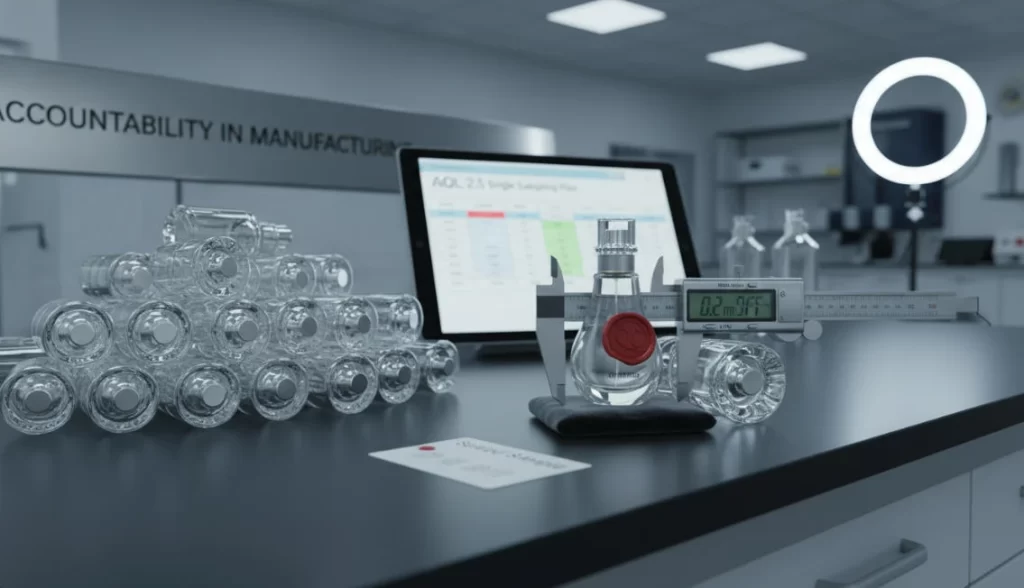
The most effective protection you have is not trust — it is documentation with teeth. The first mechanism is a Sealed Sample Agreement, where a physical, signed-off sample is retained by both parties and referenced explicitly in the purchase contract as the quality benchmark for bulk acceptance. The second is First Article Inspection (FAI), a formal process in which the first 3–5 units off the production line are reviewed and approved by the buyer — or a third-party inspector — before full production continues. FAI catches tooling drift, material substitution, and process deviations before they multiply across thousands of units.
The third mechanism is an AQL (Acceptable Quality Level) clause written directly into your purchase agreement. For packaging components in the premium fragrance category, AQL 2.5 is the industry standard — meaning that in a sample of statistically representative units drawn from your batch, no more than 2.5% can contain major defects before the shipment triggers a contractual remedy. Any credible perfume bottle factory operating at a professional level will recognize these terms. If a supplier hesitates when you introduce FAI or AQL language, that hesitation itself is data. This means you can screen for supplier professionalism before you have spent a single dollar on production.
Risk #3: The True Cost of Perfume Bottle Wholesale Is Never the Unit Price
Why Your Price Comparison Spreadsheet Is Missing Half the Numbers
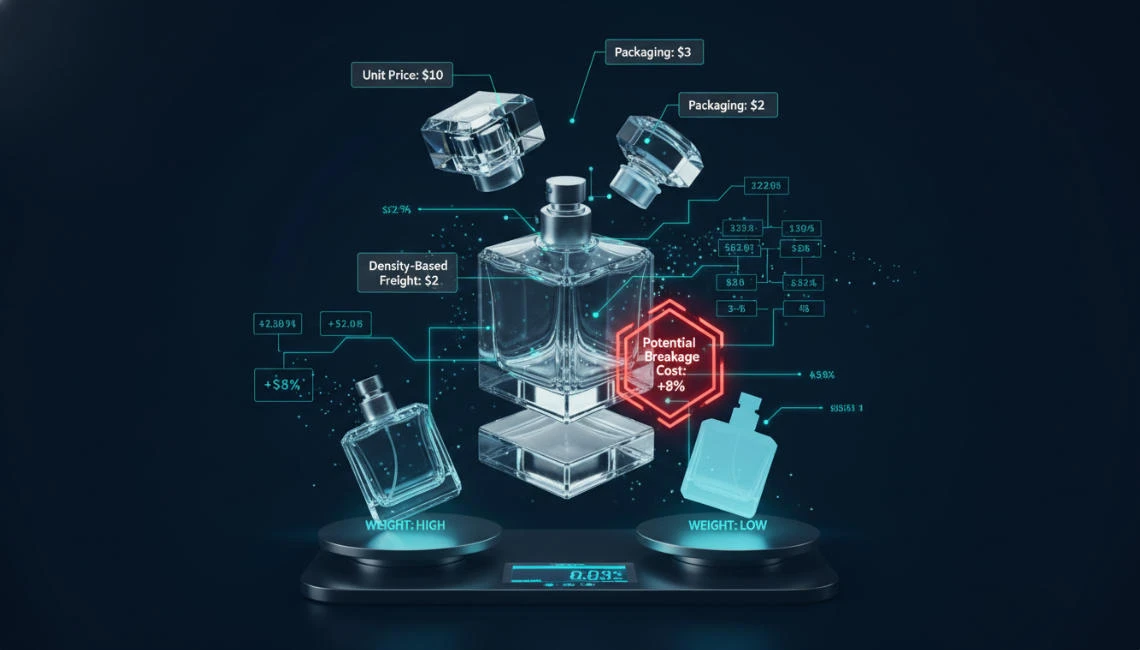
When brands evaluate perfume bottle wholesale suppliers, the comparison almost always happens on unit price — a figure that is clean, comparable, and dangerously incomplete. The actual landed cost of a crystal perfume bottle order is assembled from at least five components that rarely appear in the initial quote, and the gap between quoted price and true cost can exceed 35–40% once all variables are accounted for. Understanding this gap before you negotiate is the difference between a margin-positive product launch and an inventory position that quietly bleeds cash for two quarters.
The first hidden component is packaging materials — specifically the gift boxes, inner trays, foam inserts, and tissue wrapping that a premium fragrance product requires for both retail presentation and shipping protection. These are frequently quoted separately, or not quoted at all, by suppliers who want their per-unit bottle price to appear competitive. For a natural crystal bottle retailing above $80, the secondary packaging alone can add $3–6 per unit to your landed cost. At 2,000 units, that is a $6,000–$12,000 line item that never appeared in your sourcing comparison.
Shipping Weight, Breakage Provisions, and the Costs You Build In Too Late
Natural crystal is significantly denser than borosilicate glass or fused glass alternatives. A 100ml natural quartz perfume bottle can weigh 400–600 grams before packaging — roughly 2–3 times the weight of a comparable glass bottle. For international air freight, where pricing is calculated by either actual weight or volumetric weight (whichever is greater), this density differential has a direct and material impact on your per-unit logistics cost. Buyers who switch from glass to natural crystal without recalculating freight assumptions frequently find that their logistics line absorbs the entire margin benefit of a lower unit price negotiation.
Breakage provisions are the second cost most buyers under-budget. Without professional structural packaging — specifically, molded inner trays that immobilize each bottle individually — transit breakage rates for fragile crystal components in international sea freight can range from 3–8% of total units shipped, based on industry packaging studies. Professionally designed tray packaging, by contrast, can reduce breakage to below 1%, a reduction of approximately 15% in total breakage-related losses when measured across a standard 2,000-unit shipment. This means that investing $0.80–$1.20 per unit in structured inner packaging frequently returns $3–5 per unit in avoided replacement and reshipment costs — a ROI that is straightforward to calculate and consistently overlooked until after the first damaged shipment arrives.
Quantifying the Return and Rework Cost That Never Makes It Into the Forecast
Beyond shipping and packaging, the final hidden cost category is the operational burden of handling defective or damaged units after delivery. This includes customer service time, return shipping fees (which in cross-border e-commerce can equal or exceed the product’s wholesale cost), replacement unit sourcing, and the platform-level consequences of elevated return rates on marketplace algorithms. A seller operating on Amazon with a return rate above 8% in the luxury goods category faces suppressed listing visibility — a cost that does not appear on any invoice but directly reduces revenue from every subsequent unit sold.
When you aggregate material replacement costs, return logistics, customer service overhead, and platform-ranking impact, the effective cost of a 3% defect rate on a 2,000-unit perfume bottle wholesale order can reach $8,000–$15,000 in total business impact — on an order where the initial price difference between a reliable and an unreliable supplier might have been $2,000. This means the question is never “which supplier is cheaper?” The question is always “which supplier’s total cost of ownership is lower?” — and those two answers almost never point to the same source.
Risk #4: Seal Failure and Structural Mismatch — The Defect That Generates the Most Customer Complaints

Why a 0.2mm Tolerance Error Is Not a Minor Manufacturing Variance
In most product categories, a deviation of 0.2 millimeters is invisible to the naked eye and irrelevant to the end user. In perfume bottle manufacturing, that same deviation is the threshold between a functional product and a liability. The interface between a bottle’s neck finish and its pump or spray head operates within an extremely narrow mechanical tolerance — and when that tolerance is exceeded, the consequences compound rapidly across your entire supply chain. Leakage during transit, accelerated evaporation through an imperfect seal, and spray mechanisms that jam or misfire are all downstream symptoms of a dimensional mismatch that originates at the tooling and quality control stage of the perfume bottle factory.
The commercial impact of seal failure is disproportionate to the size of the defect itself. A bottle that arrives at your customer’s door with a damp exterior, a reduced fill level, or a non-functioning pump does not generate a quiet return — it generates a photograph, a one-star review, and a chargeback. On marketplace platforms, the algorithmic weight assigned to negative reviews in the fragrance and beauty accessories category means that a cluster of five to ten defect-related reviews can suppress your listing’s conversion rate for weeks. Research from the Baymard Institute on e-commerce return behavior indicates that product defects in the packaging category generate return rates 2.3 times higher than defects in the product itself, because packaging failure is interpreted by consumers as a signal of overall brand negligence rather than an isolated manufacturing variance.
The Three Failure Modes of Low-Quality Spray Mechanisms
Beyond the dimensional fit between bottle and pump, the spray head itself is a precision component that many perfume bottle wholesale buyers evaluate visually rather than mechanically. A spray head that looks appropriate for a luxury fragrance product and actually performs as one are not the same object. The first failure mode is spray pattern inconsistency — where the atomization quality varies between actuations, producing either a concentrated stream or an irregular mist rather than the uniform fine spray that defines a premium application experience. This failure is most commonly caused by substandard dip-tube tolerances or actuator spring inconsistency, both of which are invisible during a single-use sample evaluation.
The second failure mode is metal component corrosion. Spray heads in the mid-to-low cost segment frequently use zinc alloy or untreated steel components in their internal mechanisms. Perfume formulations — particularly those with high ethanol content or citrus-forward essential oil blends — are mildly acidic and will accelerate oxidation in unprotected metal parts. The corrosion timeline varies by formulation, but in high-humidity storage or shipping conditions, visible rust contamination inside the mechanism can develop within 60–90 days of filling. When your customer encounters rust residue in their luxury fragrance, no amount of customer service recovery returns that moment to neutral. The third failure mode is actuator fatigue — where the pump mechanism functions correctly for the first 20–30 presses and then begins to lose pressure consistency, eventually requiring multiple actuations per use. This failure mode is almost never caught in pre-shipment inspection because standard QC protocols test for initial function, not sustained performance across a realistic use cycle.
The Spray Head Testing Protocol That Separates Professional Suppliers From the Rest
Any perfume bottle manufacturer operating at a professional standard should be able to provide documented evidence of the following test protocols upon request, before you place a production order. Salt spray testing — conducted according to ASTM B117 standard — verifies the corrosion resistance of all metal components under accelerated humidity conditions equivalent to extended maritime storage. Drop testing from a minimum height of 90cm onto a hard surface verifies structural integrity of both the bottle and the spray mechanism under simulated handling conditions. Seal integrity testing, conducted by filling the bottle with ethanol and storing it horizontally for 48 hours, verifies that the pump-to-bottle interface maintains a zero-leakage seal under realistic transit orientation conditions.
If your current supplier cannot produce test documentation for these three protocols, you are not dealing with a manufacturer — you are dealing with an assembler who has outsourced quality risk entirely to you. This means that requiring test documentation before signing a purchase order is not an unreasonable demand. It is the minimum standard of due diligence that protects your brand from a category of failure that is entirely preventable and entirely invisible until it reaches your customer.
Risk #5: Transit Fragility — Why Shipping Natural Crystal Demands a Fundamentally Different Logistics Strategy
The Physical Properties That Make Natural Crystal a High-Risk Cargo Category
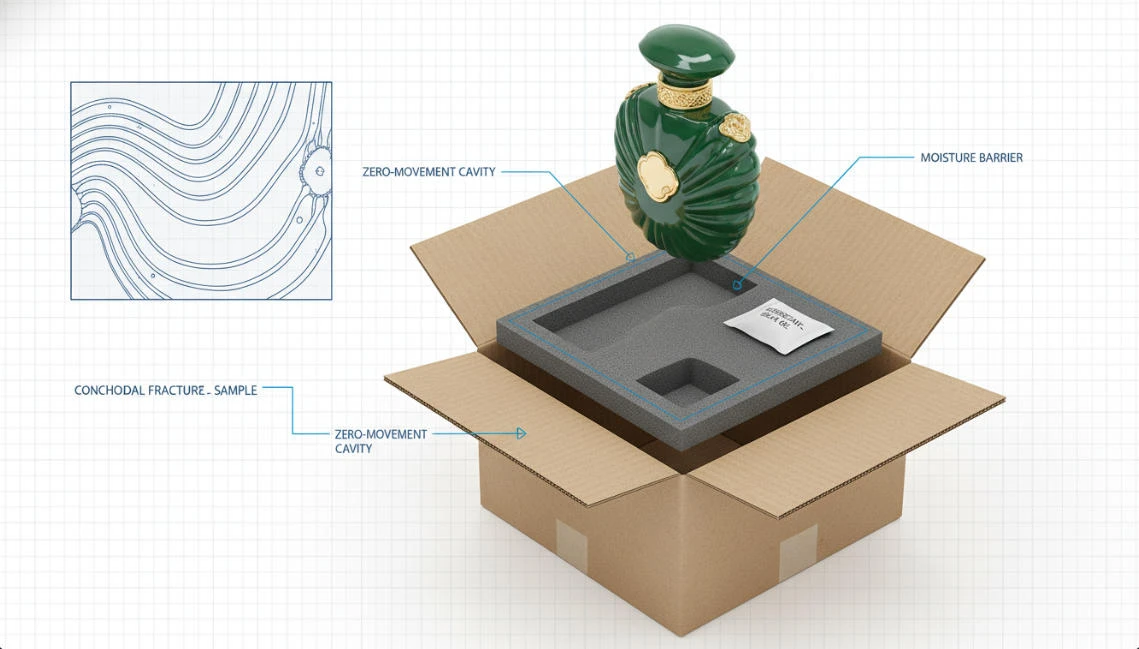
Natural crystal and semi-precious stone materials used in premium perfume bottle production — including quartz, amethyst, jade, and obsidian — share a physical characteristic that distinguishes them categorically from glass alternatives: high hardness combined with significant brittleness. On the Mohs hardness scale, quartz rates at 7.0, which means it resists surface scratching effectively. However, hardness and fracture resistance are independent properties. Natural crystal is highly susceptible to conchoidal fracture — a clean, curved break that propagates rapidly from a point of impact stress, particularly along natural crystal planes and inclusions within the stone. According to the Gemological Institute of America’s reference materials on crystal structure, this fracture behavior is an intrinsic property of crystalline mineral structure, not a manufacturing defect — and it cannot be engineered away. It can only be managed through packaging design.
What this means practically is that a natural crystal perfume bottle does not need to be dropped to break — it needs only to be allowed to move. In a standard cardboard shipping carton without structured internal support, bottles shift laterally during transit, particularly under the vibration loads of air freight or the prolonged movement dynamics of ocean freight in a standard 20-foot container. Two bottles contacting each other at a combined velocity of even 15–20 cm per second can generate sufficient localized impact stress to initiate a fracture in a natural quartz body. This is not a theoretical risk. It is a predictable outcome of applying standard glass-product packaging logic to a material with fundamentally different fracture mechanics.
How Standard Packaging Protocols Fail Natural Crystal Products
The default packaging approach used by non-specialist suppliers — a cardboard outer box, bubble wrap or foam peanuts, and individual bottles wrapped in tissue paper — is designed around the impact resistance characteristics of glass, not natural crystal. Bubble wrap distributes pressure across a surface but does not prevent the lateral movement that generates impact stress between units in a multi-bottle shipment. Foam peanuts shift and compress under sustained vibration, losing their protective geometry within the first 24–48 hours of a multi-day sea freight journey. Tissue paper provides zero structural support against conchoidal fracture initiation.
The second dimension of transit risk that standard packaging fails to address is moisture and humidity exposure. International sea freight containers are not climate-controlled environments. In trans-Pacific or Asia-to-Europe shipping lanes, containers cycle through significant temperature and humidity differentials — conditions under which paper labels, adhesive closures, and cardboard secondary packaging absorb moisture and degrade. A bottle that ships with a pristine label and intact gift box can arrive with water-stained packaging, lifting label edges, and compromised print quality that makes the product unsellable at full retail price even if the bottle itself is physically intact. This specific failure mode is invisible in air-freight sample shipments and only becomes apparent at the scale of a full sea-freight commercial order — precisely the moment when it is most expensive to discover.
The Professional Packaging Framework for International Crystal Shipments
The structural solution to natural crystal transit risk operates on three levels simultaneously. At the unit level, each bottle requires a custom-formed inner tray — molded from EPE foam or vacuum-formed plastic — that constrains the bottle completely, eliminating lateral movement regardless of outer carton orientation. The tray geometry should be designed specifically for the bottle’s dimensional profile, not adapted from a generic size. At the carton level, individual unit trays should be nested within a master carton configured so that units cannot contact each other even if the inner tray shifts — which requires a minimum 15mm clearance between tray edges and carton walls, filled with compression-resistant foam sheet rather than loose fill material.
At the environmental level, a desiccant packet rated for the cubic volume of the master carton should be sealed inside each carton before closing, providing active moisture absorption throughout the transit period. Outer carton seams should be reinforced with pressure-sensitive tape on all edges, not just the primary closing seam — a detail that adds approximately $0.15 per carton in materials cost and eliminates the humidity infiltration pathway that damages paper-based secondary packaging. Industry packaging studies in the fragile goods category indicate that this three-level structural approach reduces in-transit breakage rates from a range of 3–8% down to below 1% — a reduction that, on a 2,000-unit sea-freight order of natural crystal perfume bottles valued at $45 wholesale per unit, represents a protected inventory value of $2,700–$6,300. This means the packaging investment that prevents that loss costs a fraction of the loss it prevents — and the calculation is not close.
At Stoneelf, the packaging specifications applied to every export shipment of natural crystal and jade perfume bottles reflect 65 years of accumulated knowledge about how these materials behave under real international shipping conditions. You can request our packaging specification documentation as part of your supplier evaluation process — because understanding how a perfume bottle factory protects its product in transit tells you as much about their operational standards as their product quality certifications do.
Risk #6: MOQ Pressure and Inventory Traps — The Cash Flow Risk That Kills New Fragrance Brands Before Launch
The Minimum Order Quantity Reality That Most Suppliers Will Not Explain Upfront
The standard minimum order quantity for crystal perfume bottle wholesale production sits between 1,000 and 2,000 units for stock designs, and climbs significantly higher for custom configurations involving proprietary shapes, surface engravings, or specific semi-precious stone selections. That number is not arbitrary — it reflects the economics of tooling amortization, material procurement minimums, and production line setup costs that a perfume bottle factory must recover across each order. Understanding why MOQ thresholds exist helps you negotiate around them more intelligently than simply asking for a lower number and accepting the refusal that follows.
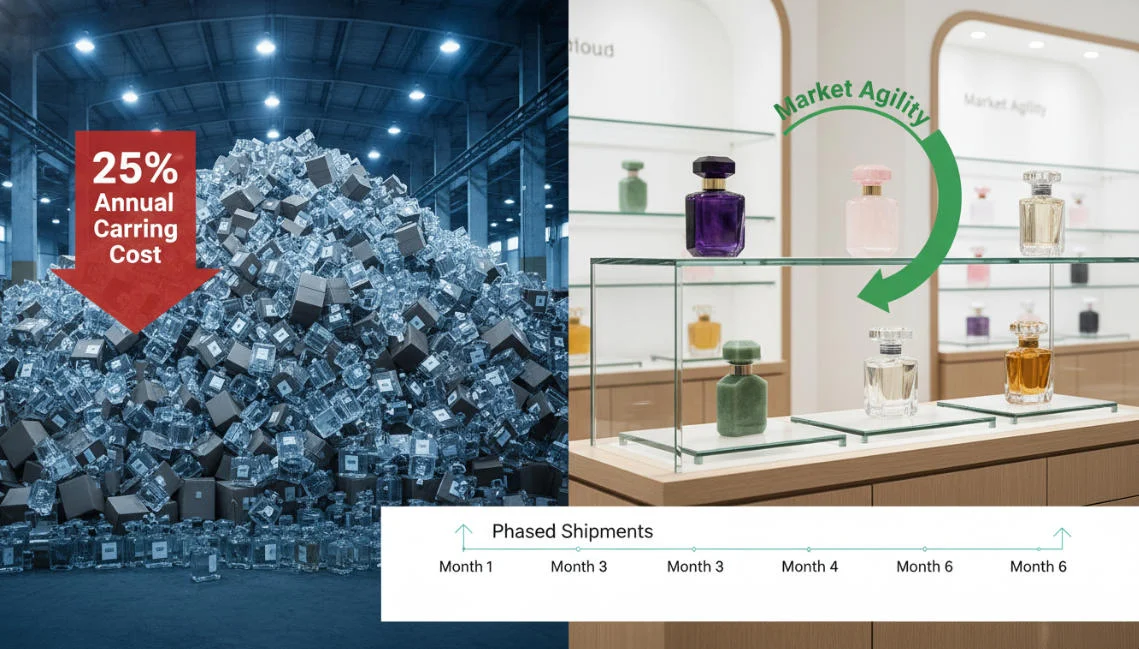
The problem for emerging fragrance brands is that 1,000–2,000 units represents a significant inventory commitment for a product that has not yet been market-validated. A brand launching a new fragrance SKU cannot reliably predict whether its first run will sell through in 60 days or sit in a 3PL warehouse for eight months. That uncertainty has a direct financial cost: warehouse storage fees accumulate on unsold inventory, working capital remains tied up in physical stock rather than available for marketing or product development, and the psychological pressure of an aging inventory position frequently drives brands into discount decisions that permanently undermine their price positioning. According to a 2023 analysis by the Consumer Goods Forum, inventory carrying costs in the beauty accessories category average 20–30% of inventory value annually when storage, insurance, opportunity cost, and obsolescence risk are fully accounted for. This means that ordering 2,000 units at $45 wholesale when you can reliably sell 800 in your first cycle does not save you money — it costs you $9,000–$13,500 in carrying burden before a single customer complains.
The Strategic Approaches That Give You Inventory Flexibility Without Sacrificing Unit Economics
The most practical path to MOQ flexibility is not negotiating the minimum down — it is restructuring the order composition to reach the supplier’s production threshold while reducing your single-SKU exposure. Mixed-SKU orders, where multiple bottle designs or stone variations are combined into a single production run, allow you to reach the factory’s minimum volume requirement while distributing your inventory risk across several product lines. A run of 400 units each across five variations achieves the same production economics as 2,000 units of a single SKU — but gives you market data on five price points and aesthetic directions simultaneously rather than one.
Phased delivery agreements represent the second strategic tool available to buyers who negotiate before signing rather than after. A phased agreement structures your total order quantity into two or three delivery tranches — for example, 1,000 units delivered at week eight and a second tranche of 1,000 units held in finished goods inventory at the factory for release at week sixteen, contingent on your sell-through performance. Not every supplier will agree to this structure, but a perfume bottle manufacturer with stable production capacity and reasonable cash flow management will recognize that a phased delivery commitment from a reliable buyer is preferable to the cost of re-soliciting new orders to fill that production capacity. Your willingness to pay a deposit on the held inventory tranche is usually the concession that makes this negotiation successful. This means that MOQ is not a fixed constraint — it is a negotiating parameter that responds to creative order structuring and financial credibility signals from the buyer.
Risk #7: Lead Time Volatility — How an Unstable Production Schedule Destroys Your Market Timing
The Gap Between Quoted Lead Times and Production Reality
A standard perfume bottle wholesale order for stock designs typically carries a quoted lead time of 30–45 days from deposit receipt to finished goods ready for shipment. Add international freight — 25–35 days for sea freight from major Chinese manufacturing hubs to US or European ports — and your total procurement cycle is 55–80 days under favorable conditions. The word “favorable” is doing significant work in that sentence. Lead times in the natural crystal and semi-precious stone processing category are subject to variability sources that do not affect glass or plastic bottle manufacturing, and those sources compound in ways that are difficult to predict from a distance.
Natural crystal and jade raw material supply is geologically constrained. Unlike glass, which can be manufactured to specification from industrial silica, natural stone must be sourced from mining operations whose output varies seasonally, geopolitically, and in response to environmental regulation. A tightening of mining permits in Yunnan province — a primary source of high-quality jade and amethyst in the Chinese supply chain — can create raw material shortages that ripple forward into production timelines with no warning to buyers who are already three weeks into an order cycle. Surface treatment processes — including sandblasting, electroplating, hand-polishing, and UV coating — each add 5–12 days to production timelines when applied to natural crystal substrates, because the material’s surface sensitivity requires longer cure times and more careful handling between process stages than synthetic alternatives.
The Business Cost of Missing Your Launch Window
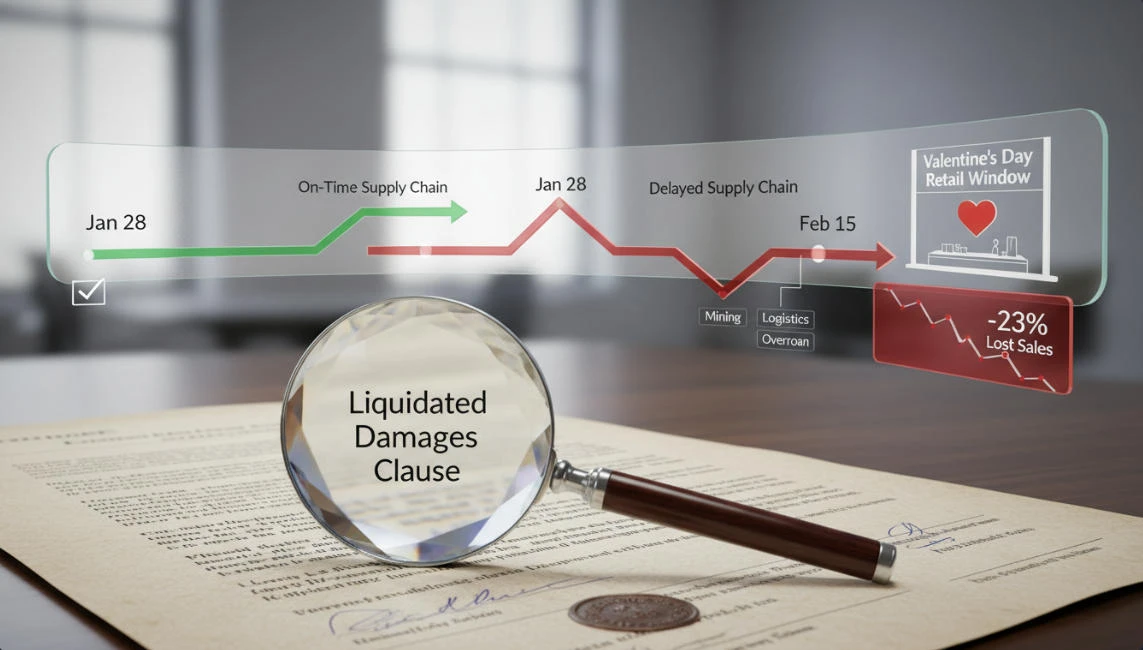
The commercial consequence of lead time overrun is not simply inconvenience — it is measurable revenue loss with a compounding structure. A fragrance brand planning a Valentine’s Day launch that requires inventory in-hand by January 28th has a hard deadline that does not flex. A 10-day production delay combined with a port congestion delay of 7 days produces a 17-day overrun — enough to convert a strategic seasonal launch into a post-holiday clearance event. According to research published by McKinsey & Company on consumer goods launch performance, products that miss their planned launch window by more than two weeks capture on average 23% less first-cycle revenue than on-time launches, because early-adopter demand dissipates rapidly and marketing spend deployed during the delay period generates lower conversion rates against unavailable inventory.
The contractual framework that protects you from lead time risk operates on three mechanisms. First, your purchase agreement should specify a Ready-to-Ship date rather than a production start date — the difference being that the production start date only obligates the factory to begin work, while the Ready-to-Ship date obligates them to complete it. Second, a weekly production status report with photographic evidence of work-in-progress should be written into your terms as a standard communication requirement, not a special request. Third, a liquidated damages clause — specifying a defined per-day penalty for delivery overruns beyond a contractual grace period — provides the financial incentive that makes on-time delivery a factory priority rather than a best-effort aspiration. This means that your lead time protection is a contract engineering problem, and the time to solve it is before your purchase order is issued, not after your launch date has passed.
Risk #8: The Low-Price Supplier Trap — Why the Cheapest Perfume Bottle Manufacturer Is Your Most Expensive Option
What Is Actually Missing When a Price Is Significantly Below Market
When you encounter a perfume bottle wholesale quote that is 25–35% below the market range for equivalent specifications, the price difference is not a negotiating win — it is a signal. Manufacturing economics are relatively transparent: raw material costs for natural crystal, labor costs for hand-finishing and engraving, quality control overhead, and packaging materials all have market-rate floors that do not compress arbitrarily. A quote that sits significantly below those floors means that one or more of these cost components has been eliminated from the supplier’s process — and the elimination is almost always in the quality control and material sourcing categories, because those are the costs that are invisible to a buyer evaluating a photograph and a price sheet.
The quality control infrastructure that distinguishes a professional perfume bottle manufacturer from a low-cost assembler includes incoming material inspection at the raw stone sourcing stage, in-process dimensional checking at each machining step, final function testing of every spray mechanism before packaging, and a documented non-conformance management system that tracks defect patterns over time and triggers process corrections. Each of these steps has a cost — in labor, equipment, and time — and none of them are optional if you want consistent output quality across a 2,000-unit production run. A supplier who eliminates them does not become more efficient. They become unpredictable in a way that the buyer absorbs entirely.
The Real ROI of Paying Market Rate for a Qualified Supplier
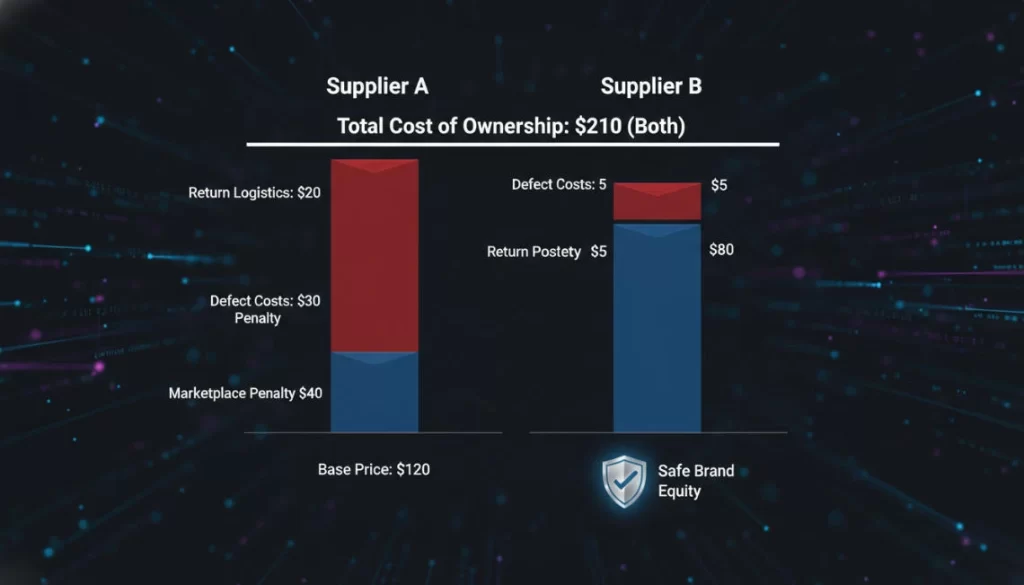
The financial case for sourcing from a qualified supplier rather than the lowest bidder is straightforward when total cost of ownership is calculated rather than unit price alone. Consider a hypothetical comparison: Supplier A quotes $38 per unit with no documented QC process, no FAI capability, and no test certification. Supplier B — a verified perfume bottle factory with documented salt spray testing, FAI protocols, and AQL 2.5 inspection — quotes $47 per unit. On 2,000 units, the initial price difference is $18,000 in favor of Supplier A.
Now apply realistic performance assumptions derived from industry data. Supplier A’s undocumented process produces a 6% defect rate — 120 units requiring replacement or credit, at an average cost of $85 per unit in replacement product, return shipping, and customer service overhead. That is $10,200 in direct defect costs. Add a conservative estimate of $4,000 in platform ranking suppression impact from negative reviews generated by defective units, and $2,500 in expedited reshipment costs for replacement inventory. Supplier A’s total cost of ownership: $94,700. Supplier B’s 2,000 units at $47, with a defect rate below 1% (20 units, $1,700 in resolution costs): $95,700. The difference is $1,000 — less than 1% of total order value — in exchange for a predictable, brand-safe outcome versus a volatile one. This means the question you should be asking your procurement team is not “how much can we save on unit price?” but “how much are we willing to pay to eliminate supply chain uncertainty from our brand’s first impression?”
The Five-Point Supplier Audit That Protects You Before You Commit
Before signing any purchase agreement with a new crystal perfume bottle wholesale supplier, your evaluation process should cover five non-negotiable verification points. First, confirm the factory’s operational history and production scope — a manufacturer with verifiable production records spanning multiple years and multiple international clients carries a fundamentally different risk profile than one whose references cannot be independently validated. Second, request raw material sourcing documentation that traces the stone or crystal material to a named mine or verified supplier network, not simply a category declaration on a spec sheet. Third, ask for the factory’s standard test protocol documentation — specifically covering seal integrity, drop resistance, and metal component corrosion resistance — and verify that these are routine procedures, not one-time demonstrations.
Fourth, request a reference contact at a current client in a comparable product category and geographic market. A perfume bottle manufacturer with legitimate professional relationships will facilitate this introduction without hesitation. A supplier who deflects, delays, or offers only written testimonials — rather than a direct conversation with a verifiable buyer — is signaling an absence of the client relationships that professional track record requires. Fifth, evaluate the supplier’s response to your quality control requirements: do they engage with FAI and AQL language as standard professional terminology, or does the conversation require extensive explanation? The fluency with which a supplier discusses quality management protocol is a reliable proxy for the depth of their actual quality system. This means your supplier audit is simultaneously a product quality screen and a professional competence evaluation — and the two are inseparable.
A Risk-Aware Procurement Framework for Serious Fragrance Brands
The Eight Risks Summarized as a Pre-Order Decision Framework
The eight risk categories documented in this article are not independent variables — they interact and compound. A supplier who misrepresents material composition is also likely to have inconsistent quality control processes, which means the sample-to-bulk gap risk and the defect rate risk are elevated simultaneously. A factory that cannot provide test documentation for seal integrity is also unlikely to have the packaging engineering expertise required to protect natural crystal in international transit — meaning that transit breakage risk and seal failure risk are correlated. Understanding these interdependencies is what separates a reactive sourcing approach — where risks are discovered after they materialize — from a proactive one, where supplier evaluation processes are designed to surface these correlations before any money changes hands.
The practical framework that emerges from this analysis has three layers. At the supplier evaluation layer, your qualification process should require material authentication documentation, test protocol evidence, and verifiable client references before any sample order is placed. At the contractual layer, every purchase agreement should incorporate a Sealed Sample Agreement, FAI requirements, AQL 2.5 inspection standards, a Ready-to-Ship date obligation, and a liquidated damages clause for delivery overruns. At the logistics layer, your packaging specification should be agreed upon and documented before production begins — not adapted from whatever the factory proposes after the bottles are finished.
Why Supply Chain Maturity Is the Differentiating Variable in This Category
The fragrance packaging market is not short of suppliers. A search for perfume bottle wholesale sources returns thousands of options across global B2B platforms, and the visual presentation of those options has become sophisticated enough that surface-level evaluation cannot distinguish a professional manufacturer from an opportunistic assembler. The differentiating variable — the one that consistently separates brands that scale successfully from those that cycle through supplier relationships every 18 months — is supply chain maturity on both sides of the transaction.
On the supplier side, supply chain maturity means documented processes, institutional quality knowledge, and the operational stability that comes from years of solving the specific problems that natural crystal and semi-precious stone manufacturing presents. On the buyer side, it means approaching procurement with the analytical framework described in this article — treating supplier evaluation as a risk management exercise rather than a price optimization exercise. Stoneelf has applied that institutional knowledge to natural crystal and jade perfume bottle production for over 65 years, across clients in the luxury fragrance, wellness, and gift categories across North America, Europe, and Asia-Pacific. The manufacturing knowledge accumulated across that period — about material behavior, packaging engineering, quality process design, and international logistics — is embedded in every production run, not bolted on as a marketing claim.
If you are currently evaluating crystal perfume bottle wholesale sources, or reassessing a supplier relationship that has not performed as expected, the most productive next step is a direct technical conversation about your specific product requirements, your target market’s quality expectations, and the quality documentation package that will accompany your order from raw material intake to final shipment. That conversation — not a price sheet — is where supply chain risk is actually managed.
Crystal Perfume Bottle Wholesale Risks Faqs
1. How can I tell if a wholesale supplier is selling real natural crystal perfume bottles or just fused glass?
Request a third-party material composition report before placing any order. Natural quartz has a measurable refractive index of 1.544–1.553 and a Mohs hardness of 7 — both figures are verifiable with standard gemological tools. Any supplier unwilling to provide documentation from a recognized testing body such as SSEF Swiss Gemmological Institute is asking you to accept a material claim on trust alone, which is not a position your brand can afford.
2. My sample looked perfect. Why should I be concerned about the bulk order quality?
Suppliers routinely invest disproportionate effort in samples because samples win purchase orders. Once production begins at scale, throughput pressure replaces the hand-finishing attention your sample received. Without a Sealed Sample Agreement, a First Article Inspection clause, and an AQL 2.5 inspection standard written into your purchase contract, you have no contractual mechanism to enforce sample-level quality across your bulk delivery.
3. What is a realistic minimum order quantity for custom natural crystal perfume bottles, and how do I manage the inventory risk?
Custom configurations typically require 1,000–2,000 units at minimum, with higher thresholds for proprietary shapes or specific stone selections. You can reduce single-SKU inventory exposure by structuring mixed-SKU orders across multiple designs within a single production run, or by negotiating phased delivery tranches that release finished inventory against your actual sell-through performance rather than a fixed delivery schedule.
4. What packaging standard should I require to protect natural crystal bottles during international sea freight?
Require custom-formed EPE foam or vacuum-formed inner trays specific to your bottle’s dimensional profile, a minimum 15mm compression-resistant foam buffer between tray edges and carton walls, and a rated desiccant packet sealed inside each master carton. Packaging validated against ISTA Series 2 and ASTM D4169 test standards reduces transit breakage from the 3–8% range typical of unstructured packaging to below 1% — a difference that on a 2,000-unit order represents $2,700–$6,300 in protected inventory value.
5. How do I evaluate whether a crystal perfume bottle manufacturer is operationally qualified before committing to an order?
Five verification points define the minimum threshold: confirmed ISO 9001:2015 certification from an accredited third-party body, raw material sourcing documentation traceable to a named supplier network, standard test protocol records covering seal integrity, drop resistance, and ASTM B117 corrosion testing, a direct reference contact at a current client in a comparable market, and demonstrated fluency with FAI and AQL 2.5 terminology in purchase negotiation. A supplier who cannot satisfy all five points is transferring quality risk onto you — at a stage where your remediation options are limited and expensive.
