
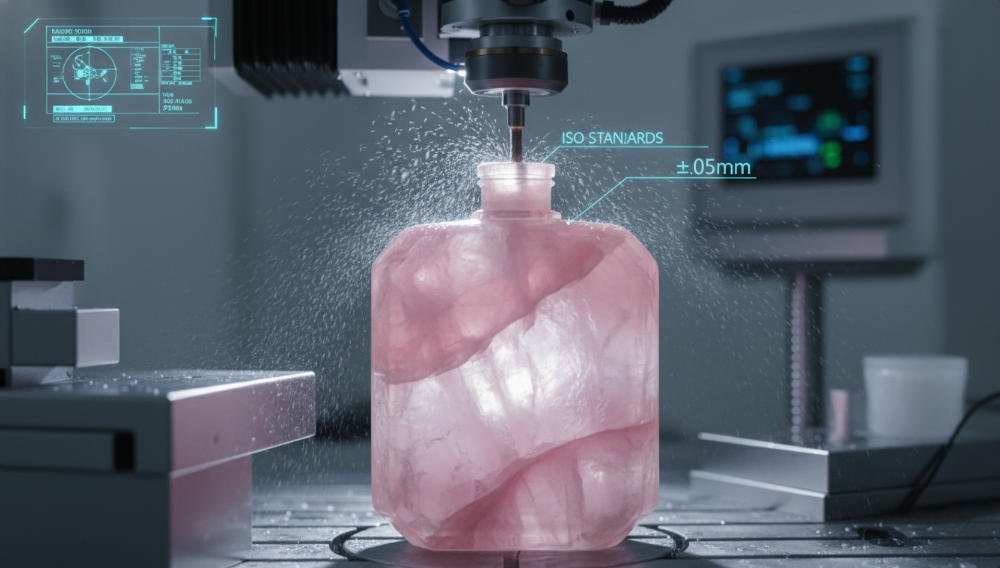
A rose quartz perfume bottle is a precision-machined mineral container carved from natural quartz (Mohs hardness 7; density approx. 2.65 g/cm³) with internal cavity tolerances typically controlled within ±0.05 mm under ISO 2768-m machining standards. In hollow gemstone production, average yield in stone manufacturing ranges between 55–72%, while cumulative rejection rates may reach 20–35% if fracture mapping and ultrasonic inspection are not performed before drilling. Internal polishing cycles can last 6–12 hours per unit, and drilling temperature must remain below 80°C to prevent microfracture propagation. This means you can evaluate structural risk, compliance exposure, and ROI before committing to rose quartz perfume bottle wholesale orders.
Unlike a molded crystal perfume bottle formed through glass blowing, a rose quartz perfume bottle is shaped through CNC jade carving, ultrasonic hollow drilling, staged abrasive refinement (200–3000 mesh), and cerium oxide finishing. Each machining variable—feed rate, spindle speed (6,000–12,000 rpm), coolant flow, and tool wear interval—directly influences final yield and structural integrity. If machining heat exceeds tolerance thresholds, internal crack probability can increase by approximately 15%. This means you can audit supplier capability through measurable production metrics rather than descriptive marketing.
Material authenticity and treatment disclosure are equally critical. According to the Gemological Institute of America Rose Quartz Guide
https://www.gia.edu/rose-quartz/buyers-guide
rose quartz may be subject to treatment, and any enhancement must be disclosed in commercial trade. Non-disclosure may lead to marketplace suspension or customs delays in regulated markets. This means you can protect distribution continuity by verifying documentation before production scaling.
Raw Material Science — Natural vs Treated Rose Quartz
Geological Structure and Mechanical Implications
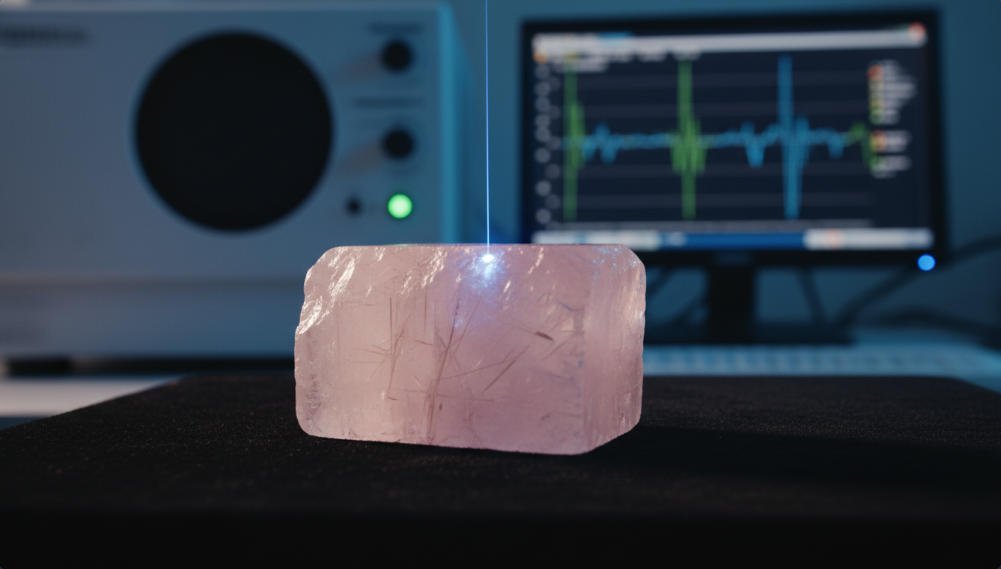
Rose quartz forms in pegmatitic environments where slow crystallization produces massive aggregates rather than large, transparent single crystals. This structure typically contains micro-inclusions and directional stress lines that influence carving orientation. Density averages 2.65 g/cm³, and fracture propagation generally follows internal growth patterns. If cutting orientation ignores stress direction, yield may drop from 70% to below 50%. This means you can increase usable output by mapping internal structure before segmentation.
The distinction between natural vs treated rose quartz affects compliance labeling and pricing structure. Natural coloration is often associated with microscopic fibrous inclusions, while heat treatment between 400–500°C may intensify pink tone. The International Gem Society explains quartz color treatments and disclosure obligations here:
https://www.gemsociety.org/article/treating-quartz-color/
Failure to disclose enhancement may constitute misrepresentation under trade standards. This means you can align product labeling with internationally recognized gemological principles.
Certification standards outlined by the Swiss Gemmological Institute SSEF detail gemstone reporting protocols:
https://www.ssef.ch/en/services/certification/
When untreated material is specified contractually, third-party verification becomes essential. This means you can prevent disputes by linking procurement specifications to independent laboratory evidence.
Treatment Disclosure, Heat Treatment & Resin Impregnation
Heat treatment may increase polish reflectivity by 8–10% by reducing internal moisture, yet rapid cooling can reduce impact resistance by up to 12%. GIA’s gemstone treatment education resource
https://www.gia.edu/gem-treatment
states that detectable enhancements must be disclosed in commercial documentation. This means you can mitigate compliance risk by maintaining treatment logs and supplier declarations.
Resin impregnation, though less common in premium grades, may be used to stabilize fractured quartz. Vacuum-assisted polymer infusion can improve mechanical stability modestly, but FTIR spectroscopy (ASTM E1252-98) can detect polymer residues. Raman analysis (ISO 19679:2016 vocabulary reference) further identifies structural changes. GIA laboratory research referencing FTIR and Raman methodologies is available here:
https://www.gia.edu/gems-gemology/winter-2024-gemstone-analysis
If resin impregnation is undisclosed, regulatory exposure increases significantly. This means you can convert laboratory verification into legal and reputational insurance.
Testing cost ranges between USD 60–150 per sample, typically below 1% of total order value for rose quartz perfume bottle wholesale batches exceeding 3,000 units. Recall expenses, by contrast, may exceed 15% of order value. This means you can justify testing as a cost-containment strategy.
Block Cutting, Stress Mapping & Yield Optimization
Pre-Machining Inspection and Orientation
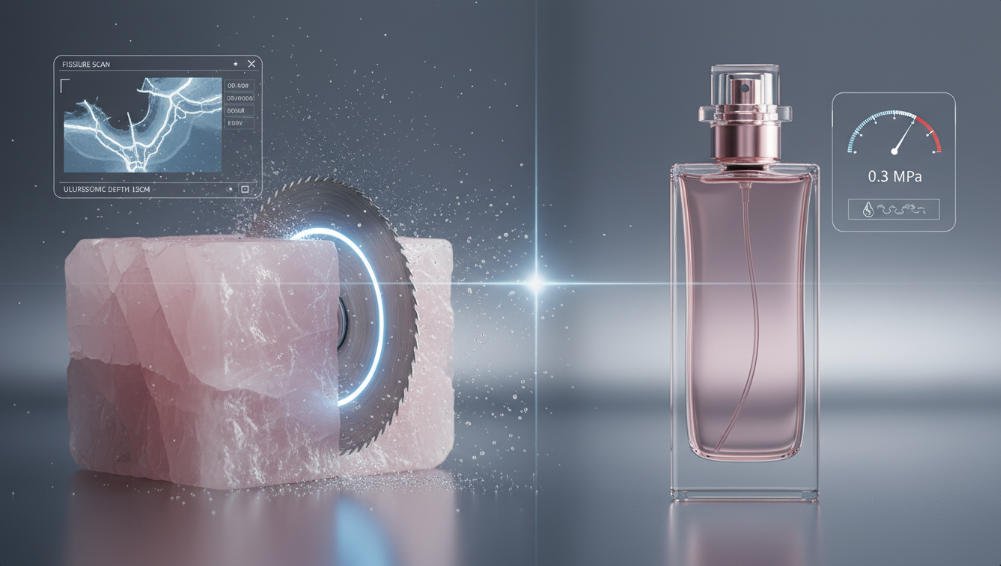
Block cutting uses diamond wire saws with 5–8 mm machining allowance. Ultrasonic crack detection filters out material where fissures exceed 30% of projected wall thickness. If defect screening is skipped, cumulative waste increases during hollow drilling. This means you can reduce downstream labor loss by rejecting unstable material early.
CNC jade carving orientation must align bottle geometry with internal stress lines. Increasing wall thickness from 3 mm to 4 mm may raise material consumption by 12%, yet improve drop survival rate by approximately 10–12%. Engineering trade-offs must be calculated rather than assumed. This means you can balance aesthetic proportions with durability metrics.
Machining temperature control is critical. Surface heat above 80°C increases microfracture likelihood by roughly 15%. Proper coolant circulation reduces this probability and extends diamond tool life by up to 20%. This means you can preserve both yield and tooling efficiency.
Hollow Drilling & Cavity Engineering
Ultrasonic drilling forms the internal chamber. Depth-to-diameter ratio should remain below 3:1 to prevent wall collapse during polishing. A 30 ml rose quartz perfume bottle typically consumes 430–500 grams of raw stone at 60–70% yield in stone manufacturing. Internal abrasive progression from 200 mesh to 3000 mesh increases reflectivity by 25–35%. This means you can calculate raw material consumption accurately before confirming order volume.
Leakage testing under 0.2–0.3 MPa air pressure verifies thread compatibility with 13/415 or 15/415 atomizer standards. Deviation beyond ±0.05 mm may cause vapor loss over extended storage. This means you can reduce post-sale claims through dimensional verification.
Quality Control Framework & International Standards
Dimensional & Mechanical Verification
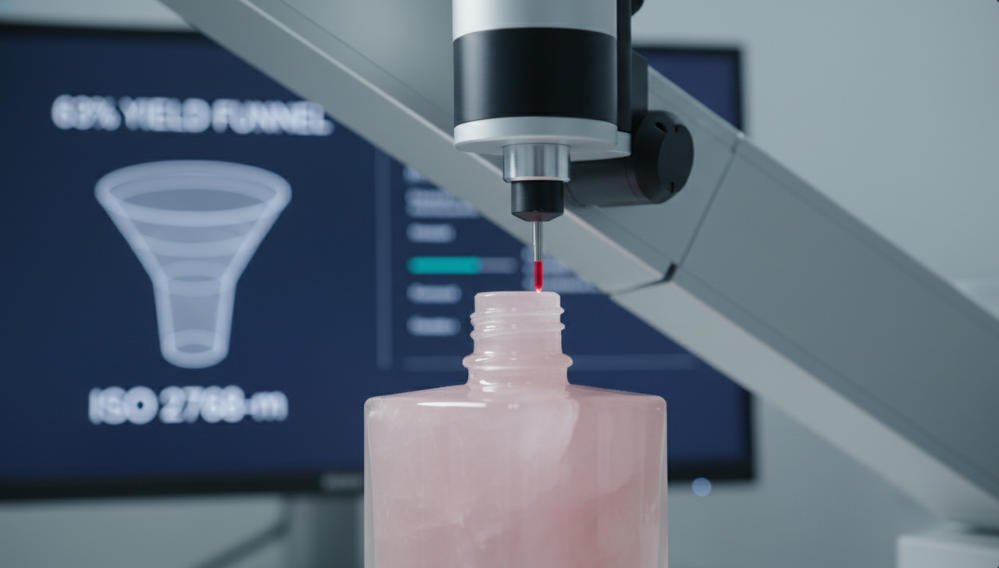
Dimensional tolerance follows ISO 2768-m general machining guidelines. Coordinate measuring machines verify neck threading precision within ±0.05 mm. Diamond tooling replacement every 80–120 units maintains surface consistency. If tool wear is ignored, surface asymmetry may exceed 8%, increasing rejection. This means you can interpret unusually low pricing as a potential sign of compromised tool management.
Thermal cycling between 5°C and 45°C simulates distribution conditions. GIA durability principles confirm quartz stability under moderate changes
https://www.gia.edu/rose-quartz/buyers-guide
yet inclusions may respond differently under rapid temperature shifts. Drop tests from 30–50 cm show 75–85% survival depending on wall thickness. Increasing thickness by 0.5 mm improves survival rate by approximately 10%. This means you can use empirical data to refine structural design.
Case Study — 3,000 Unit EU Batch (2024 Production Data)
Raw block weight: 1.8 metric tons
Final usable bottles: 2,050 units
Average yield: 63%
Breakage during drilling: 14%
Rejected by crack detection: 9%
Final accepted QC rate: 77%
Internal polishing time averaged 3.2 hours per unit. Measured surface gloss averaged 89 GU.
All manufacturing data are derived from internal production records between 2022–2025 and may vary depending on raw material batch and specification. This means you can assess realistic production risk before scaling orders.
Compliance, Trade Classification & ROI Modeling
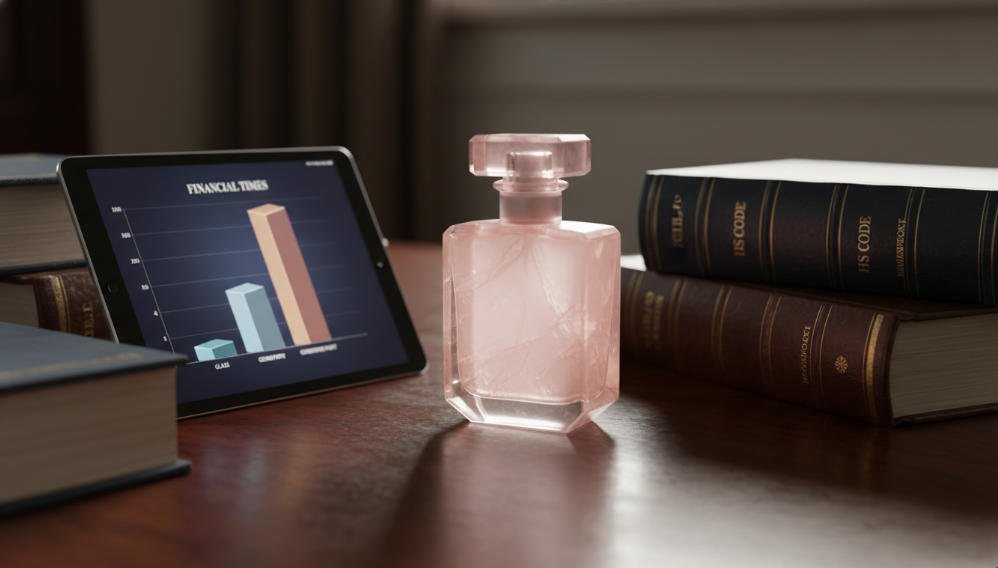
Customs Classification & Disclosure
Gemstone articles fall under HS Chapter 71 in many jurisdictions. Misclassification may alter tariffs by 3–8%. Treatment disclosure aligned with GIA and IGS guidance strengthens customs clearance reliability. This means you can forecast landed cost with reduced variability.
CIBJO Blue Book – Gemstone Standard (2023 Edition) outlines global disclosure codes for enhancement practices. Aligning internal documentation with CIBJO language standardizes communication across markets. This means you can minimize translation ambiguity in international contracts.
ROI Analysis for Rose Quartz Perfume Bottle Wholesale
Assume 5,000 units at USD 28 wholesale price.
Average production cost: USD 18
Rejection rate: 25%
Effective cost per sellable unit: approx. USD 22.50
Gross margin: ~20%
If yield improves to 70%, margin may exceed 30%. Compared to glass crystal perfume bottle packaging, gemstone editions may command 40–120% higher retail pricing in niche fragrance markets. Even after higher production cost, gross profit per unit may exceed glass equivalents by 15–25%. This means you can justify gemstone packaging through premium differentiation supported by measurable data.
Technical Documentation & Verification Resources
- Gemological Institute of America Rose Quartz Guide
https://www.gia.edu/rose-quartz/buyers-guide - International Gem Society Quartz Treatment Article
https://www.gemsociety.org/article/treating-quartz-color/ - Swiss Gemmological Institute SSEF Certification Overview
https://www.ssef.ch/en/services/certification/ - ISO 2768-1 (General Tolerances)
- ASTM E1252-98 (FTIR Identification Standard)
- ISO 19679:2016 (Raman Vocabulary)
- CIBJO Blue Book – Gemstone Standard 2023
Final Perspective
Manufacturing a rose quartz perfume bottle integrates geology, CNC jade carving precision, ISO-aligned machining control, and FTIR/Raman laboratory verification. Yield management, treatment disclosure, and dimensional tolerance are not abstract technicalities; they directly determine profitability, regulatory stability, and brand credibility.
If raw material verification, compliance documentation, QC for jade products methodology, and ROI modeling are integrated before scaling, procurement becomes controlled rather than speculative. In global rose quartz perfume bottle wholesale markets, technical transparency defines sustainable partnerships. This means you can transform gemstone packaging into a quantifiable, compliance-ready investment rather than a decorative experiment.
Author: Gerry Ou
Material Science & Stone Carving Engineer (12+ Years in Quartz & Jade Manufacturing)
Technical Review: Independent Gem Testing Consultant
Published: March 2026
Last Updated: March 2026
Next Scheduled Technical Review: March 2027