
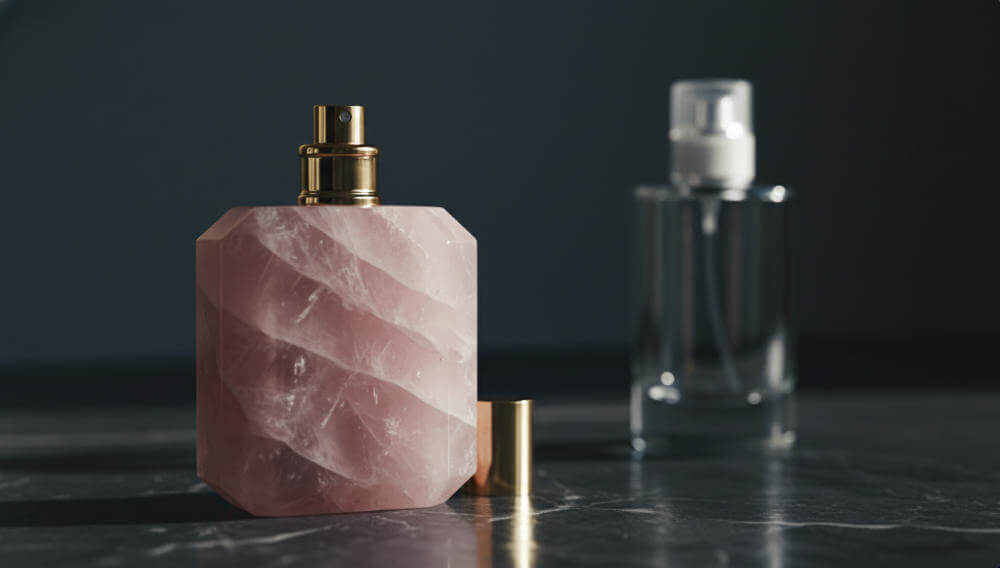
In the fine fragrance industry, packaging is never a purely functional decision. From a manufacturing perspective, the perfume bottle itself often determines whether a fragrance is positioned as mass-market, premium, or collectible. As a manufacturer specializing in natural crystal perfume bottles and stone-based fragrance accessories, Stone Elf is frequently asked why a crystal perfume bottle carries a significantly higher price than a conventional glass bottle.
At a surface level, crystal and glass may appear similar. Both are transparent, both can be shaped into elegant forms, and both serve the same basic containment function. However, once production begins, the similarities end quickly. Differences in raw material sourcing, yield efficiency, processing risk, labor structure, and product positioning create a fundamentally different cost system. This article examines those differences in detail from the perspective of a crystal perfume bottle manufacturer.
Raw Material Cost: Why Natural Crystal Sets a Higher Cost Baseline Than Glass
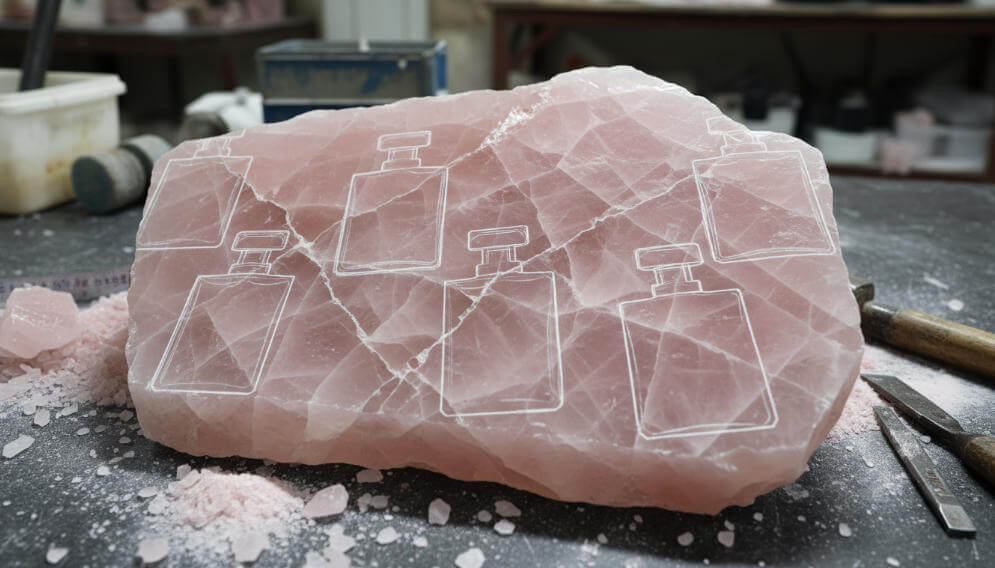
In crystal perfume bottle manufacturing, raw material cost is not simply a purchasing issue—it defines the entire production logic. Natural crystal, including quartz, jade, and related mineral stones, is extracted from geological deposits formed over millions of years. This immediately places crystal in a different cost category than industrial glass, which is produced from abundant, chemically standardized raw inputs.
From a manufacturer’s perspective, the most critical distinction lies in material predictability. Industrial glass raw materials behave consistently during melting and molding. Natural crystal does not. Each block carries unique internal structures, including fissures, inclusions, and stress lines that are invisible until cutting begins. As a result, material selection itself becomes a skilled operation rather than a routine procurement task.
In practical production terms, only a portion of mined crystal blocks meet the structural and aesthetic requirements for perfume bottle manufacturing. Based on workshop-level processing experience, usable yield from raw crystal blocks typically falls within the 35–55% range, depending on clarity, internal fracture density, and bottle geometry. By contrast, glass perfume bottle manufacturers commonly achieve raw material efficiency above 85–90%, supported by controlled melting and mold-based forming.
This structural gap means that before any labor, machining, or finishing costs are added, a crystal perfume bottle already carries a significantly higher material cost per usable unit. According to the U.S. Geological Survey (USGS), while quartz is geologically abundant, material suitable for high-clarity and precision decorative applications represents only a limited subset of commercially extracted quartz due to purity and structural requirements.
Source: U.S. Geological Survey – Quartz Statistics and Information https://www.usgs.gov/centers/national-minerals-information-center/quartz-statistics-and-information
Material Loss and Yield Risk: A Structural Cost Factor in Crystal Bottle Production
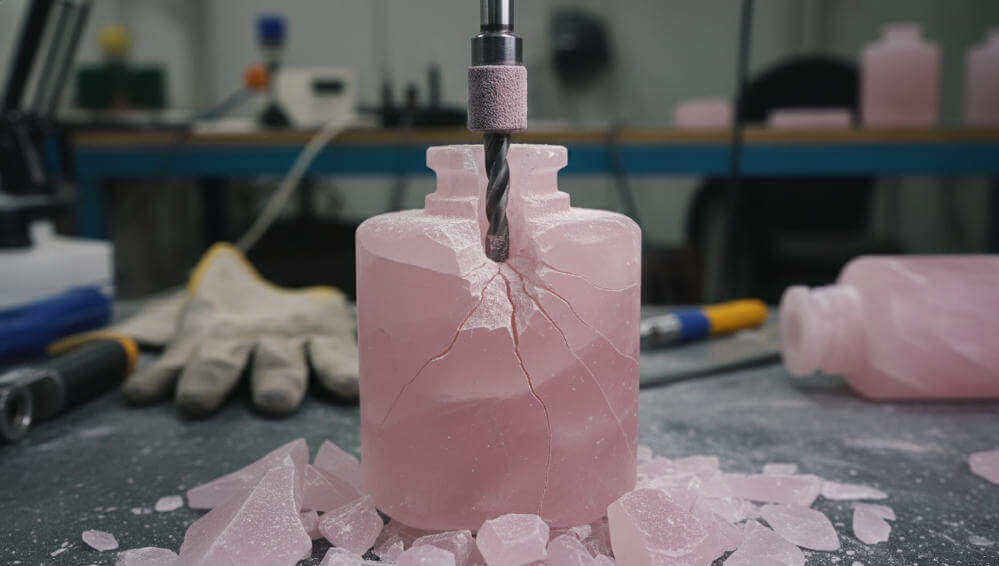
Material loss is not an operational accident in crystal perfume bottle manufacturing; it is a structural reality. Unlike glass, which is shaped in a molten state, crystal bottles are produced through subtractive processes such as cutting, drilling, and hollowing. Each step permanently removes material and exposes internal weaknesses that cannot be predicted with absolute certainty.
During hollowing and drilling, internal stress redistribution can cause sudden crack propagation. Even with conservative cutting speeds and staged drilling, microfractures may only become visible after several hours of machining. This means that a crystal bottle can fail late in the production cycle, after substantial labor and time investment has already been committed.
From a manufacturing risk perspective, this creates a cost profile fundamentally different from glass. For medium-complexity crystal perfume bottles, total process loss—including raw material rejection and mid-process failure—can reach 45–60%. These losses must be absorbed into the pricing of successful units, increasing the final cost per bottle.
Industry guidance from stone processing organizations consistently notes elevated waste ratios in decorative stone manufacturing, particularly for hollow or precision-drilled objects.
Reference: Natural Stone Institute – Industry Information on Stone Processing https://www.naturalstoneinstitute.org/industry-information/
Glass perfume bottle production follows a different risk model. Defect rates are statistically predictable, and failures typically occur early in the molding process. Once a glass bottle passes annealing and cooling, the likelihood of catastrophic failure drops sharply. This predictability allows glass manufacturers to optimize cost through scale, something that crystal bottle workshops cannot replicate without compromising structural integrity.
Labor Cost: Skilled Handcraft Versus Industrial Automation
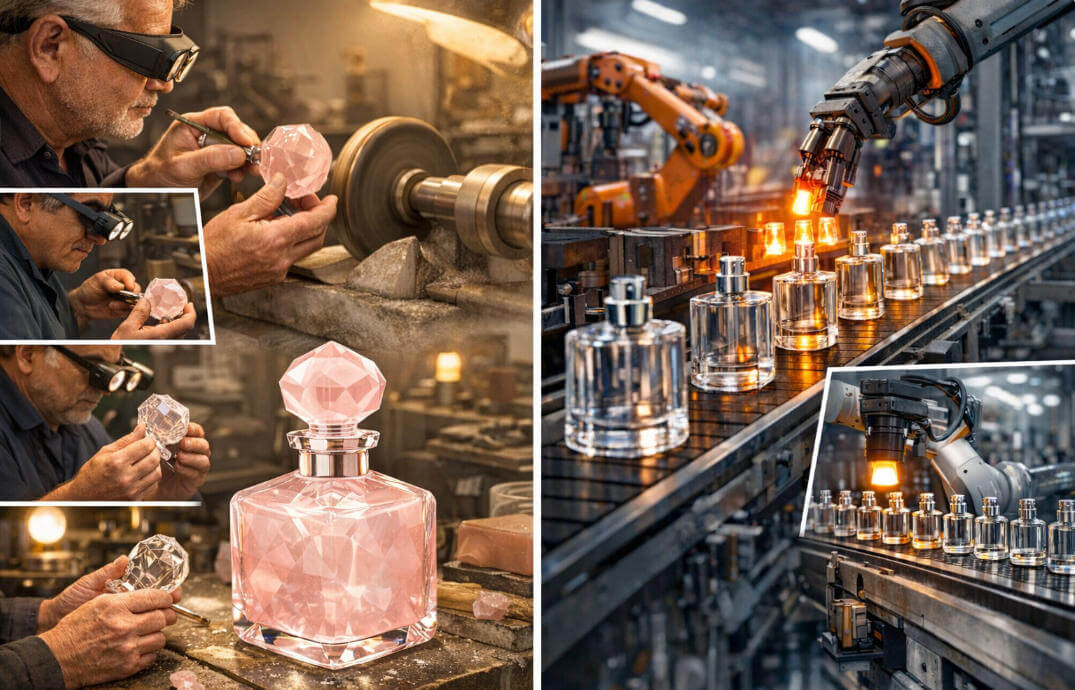
Labor structure represents one of the most visible cost differences between crystal and glass perfume bottles. Crystal perfume bottle production relies heavily on skilled artisans trained in stone cutting, precision drilling, and surface polishing. These skills require years of hands-on experience and cannot be easily replaced by automated systems.
In a typical crystal bottle workflow, a single piece may pass through multiple specialists, including cutting technicians, drilling operators, polishing artisans, and quality inspectors. Each stage requires manual judgment and constant adjustment based on material behavior. According to the International Labour Organization (ILO), craft-based manufacturing roles typically involve long training cycles and limited automation potential, resulting in structurally higher labor input per unit compared to industrial manufacturing.
Source: International Labour Organization – Skills and Employability https://www.ilo.org/global/topics/skills-knowledge-and-employability/lang–en/index.htm
By contrast, glass perfume bottle manufacturing benefits from decades of automation. Modern factories rely on robotic molding lines, automated annealing systems, and machine-based inspection. Once a mold is established, thousands of identical bottles can be produced with minimal human intervention, dramatically reducing labor cost per unit.
Processing Time and Production Speed
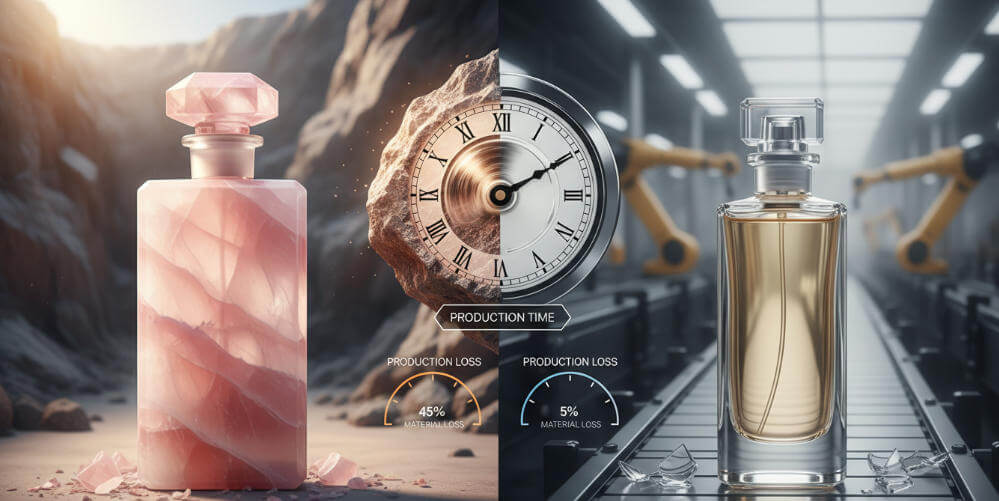
Time is a hidden but critical cost factor in crystal perfume bottle production. A single crystal bottle may take several days to complete, particularly when thick walls or complex internal cavities are involved. Slow drilling, staged polishing, and stress-relief pauses are necessary to avoid cracking.
From a manufacturer’s perspective, slower production directly increases cost. Lower output per worker, longer lead times, and higher overhead allocation per unit all contribute to a higher final price. Rushing production often results in complete material loss, making speed an unreliable optimization lever.
Glass perfume bottles, by comparison, can be produced in minutes once molds and parameters are finalized. This speed allows glass manufacturers to amortize equipment and overhead costs across very large volumes, reinforcing their cost advantage.
Surface Finishing and Aesthetic Complexity
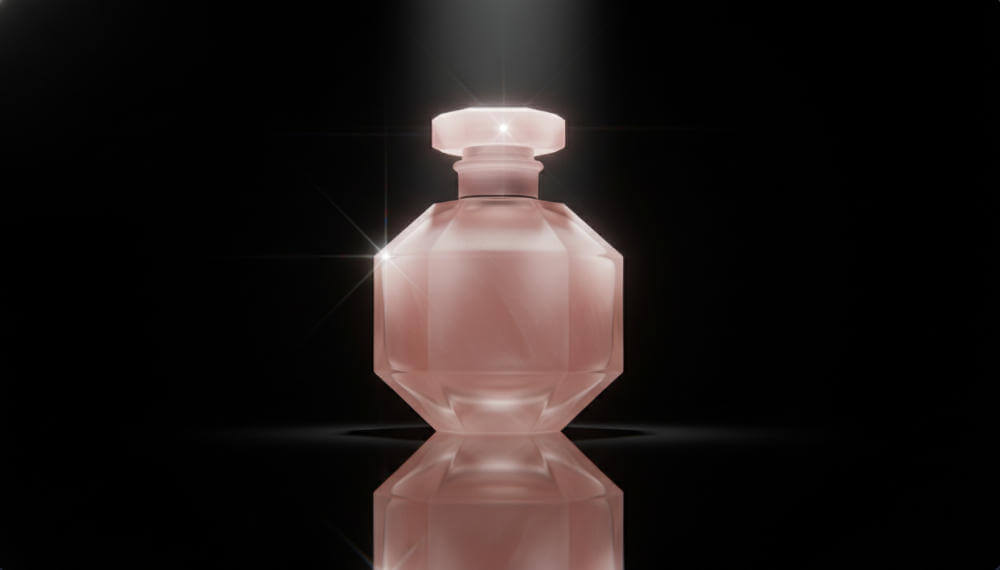
Surface finishing is a defining value component of a crystal perfume bottle. Achieving a mirror-like polish on natural stone requires multiple stages of manual and mechanical polishing using progressively finer abrasives. Each surface must be treated individually, and natural inclusions must be managed carefully to avoid weakening the structure.
The Gemological Institute of America (GIA) identifies surface finish as a core value factor in crystal and gemstone products, as finishing quality directly affects light interaction, durability, and perceived craftsmanship.
Source: Gemological Institute of America – Gem Quality Factors https://www.gia.edu/gem-quality-factor
This finishing process adds time, labor, and inspection costs that cannot be eliminated without compromising quality.
Glass surfaces, by contrast, are naturally smooth after molding. Additional treatments such as frosting, coating, or printing are compatible with automated systems, making finishing faster and more cost-efficient.
Design Constraints and Customization Cost
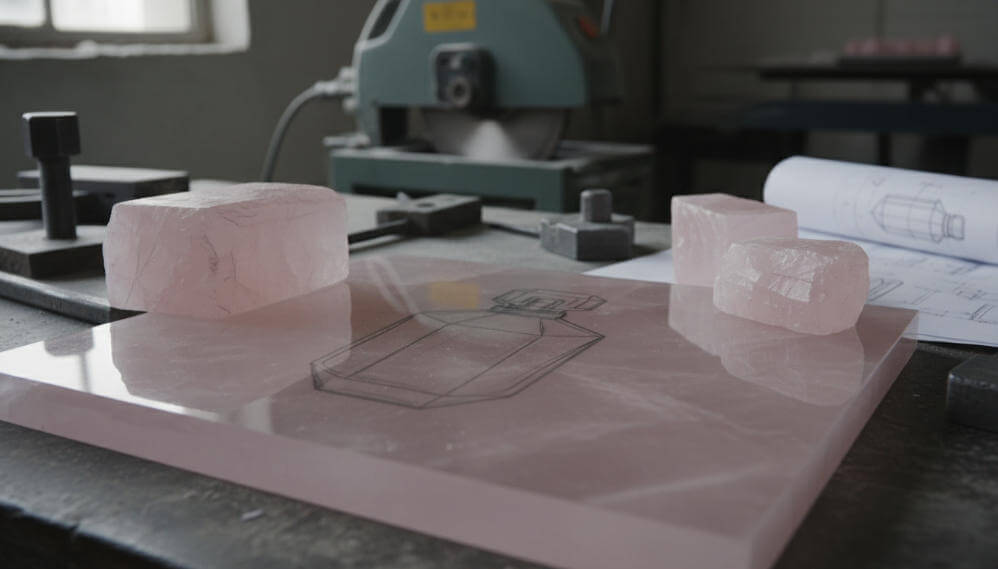
Design flexibility differs significantly between crystal and glass. Crystal does not tolerate aggressive geometry. Thin walls, sharp internal corners, or deep cavities dramatically increase fracture risk during production. As a result, every crystal perfume bottle design must be evaluated from a structural perspective before aesthetic considerations are finalized.
Customization is possible, but expensive. Each new design requires prototype testing, tooling adjustments, and acceptance of higher early-stage loss. Glass bottle design, once a mold is created, can be replicated indefinitely with minimal incremental cost, making customization far more scalable.
Manufacturer Perspective: Why Crystal Perfume Bottle Costs Cannot Follow Glass Economics
As a manufacturer specializing in natural crystal perfume bottles, caps, and stone-based fragrance accessories, Stone Elf operates at the material-processing end of the perfume industry. Our focus lies in stone sourcing, precision cutting, hollowing, and finishing rather than fragrance formulation or mass-market packaging.
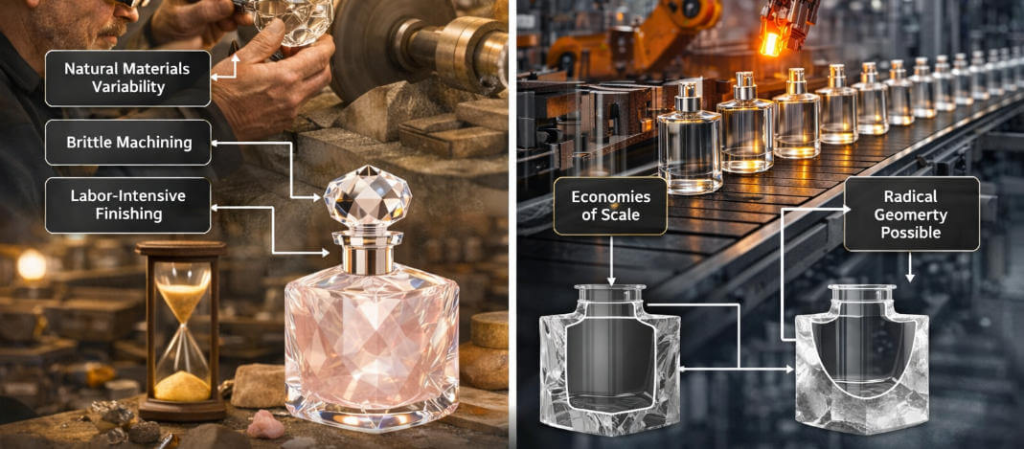
This position defines how cost is evaluated. Crystal perfume bottles are governed by constraints that do not apply to glass production, including natural material variability, fracture-sensitive machining, and labor-intensive finishing. These constraints prevent crystal bottles from benefiting fully from economies of scale, even when production volume increases.
Design decisions further reinforce this cost structure. Wall thickness, internal cavity depth, and curvature are limited by stress distribution rather than aesthetics alone. Aggressive geometries achievable in glass molding would significantly increase failure risk in crystal, making conservative design an engineering necessity.
Product Positioning and Market Expectations
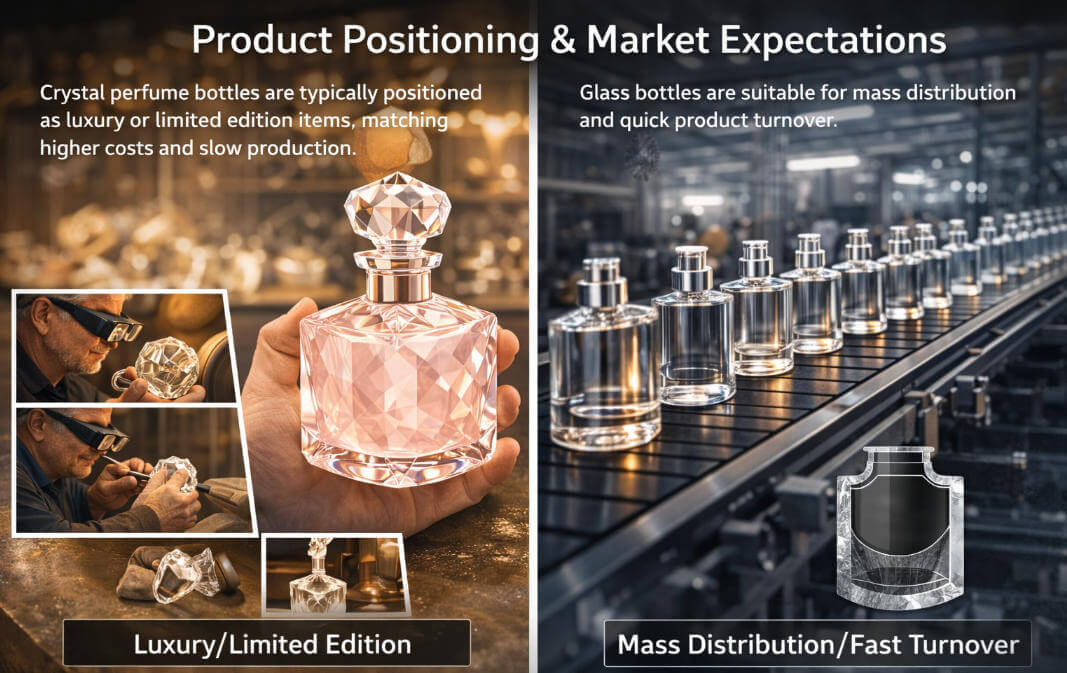
Crystal perfume bottles are typically positioned as luxury or limited-run items. From a manufacturing standpoint, this positioning aligns with the realities of production. Higher material loss, slower output, and skilled labor requirements are incompatible with low-margin, high-volume distribution.
Market analysis by Bain & Company shows that consumers associate handcrafted materials and natural resources with higher perceived value, particularly in luxury and limited-run product categories.
Source: Bain & Company – Luxury Goods Worldwide Market Study https://www.bain.com/insights/luxury-goods-worldwide-market-study/
Glass bottles, meanwhile, are well suited to broad distribution and frequent product turnover.
Transportation, Handling, and Risk Management Costs
Crystal perfume bottles are heavier and more fragile than glass bottles of similar size. This increases costs related to protective packaging, insurance, and transportation. Industry guidance from logistics organizations consistently notes that fragile stone products incur higher per-unit shipping costs.
Glass bottles benefit from lighter weight and standardized packaging formats, making logistics more predictable and cost-efficient at scale.
References and Industry Sources
- U.S. Geological Survey (USGS) – Quartz Statistics and Information
- Natural Stone Institute – Stone Processing Industry Information
- Gemological Institute of America (GIA) – Gem Quality Factors
- International Labour Organization (ILO) – Skills and Employability
- Bain & Company – Luxury Goods Worldwide Market Study
Conclusion: Why Higher Crystal Perfume Bottle Prices Are Structurally Inevitable
From a manufacturer’s perspective, the higher cost of a crystal perfume bottle is not the result of branding alone. It is the cumulative outcome of natural material scarcity, significant yield loss, skilled labor dependence, extended production time, and intentional luxury positioning.
It is important to note that this analysis reflects manufacturing-stage cost structures rather than retail pricing strategies. Crystal perfume bottles are typically used in projects where material authenticity and craftsmanship outweigh economies of scale. For brands and consumers who value these qualities, the higher price of a crystal perfume bottle represents not excess, but substance.
