

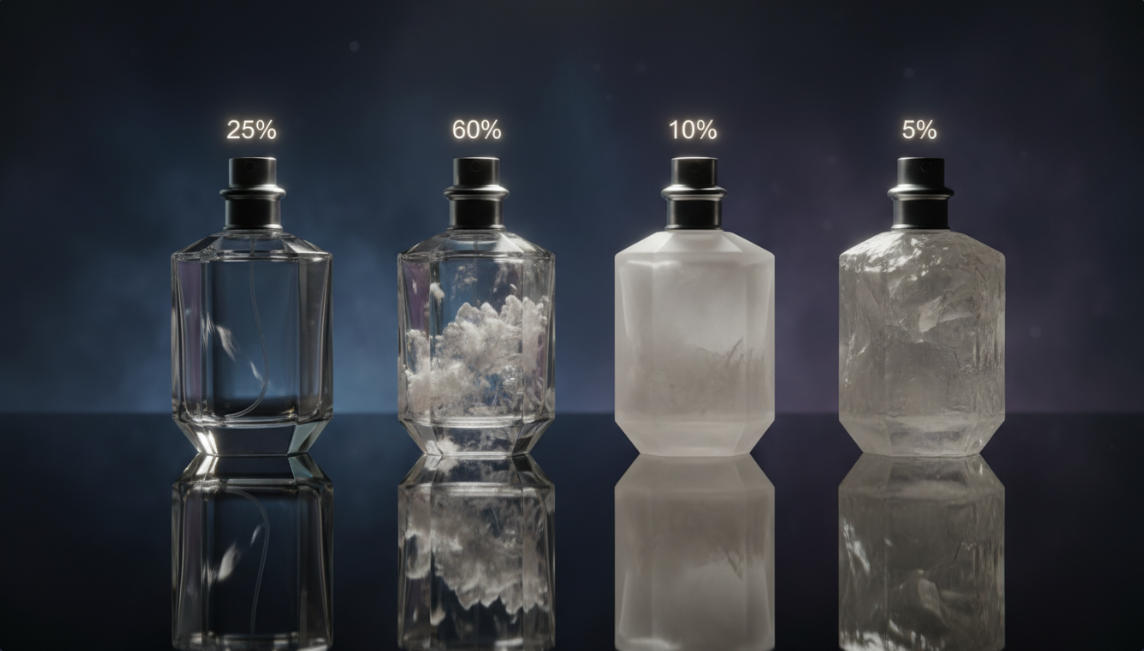
If you are evaluating a perfume bottle manufacturer for your next wholesale order, start with this number: based on Stone Elf’s 2025 full-year production data covering approximately 600,000 natural crystal perfume bottles, only 25% of total output qualifies as premium grade. A further 60% reaches standard quality, 10% falls into the low-grade category, and 5% is classified as unusable waste. This means that even inside a rigorously managed crystal perfume factory, three out of every four bottles will never reach top-tier status — regardless of what the equipment list says or what is promised during the sales call. Before you commit to your next perfume bottle wholesale order, you need to understand exactly what determines the quality that arrives at your warehouse door — and whether your current supplier can account for it.
Why Quality Standards Define the Business Outcomes of Every Perfume Bottle Wholesale Decision
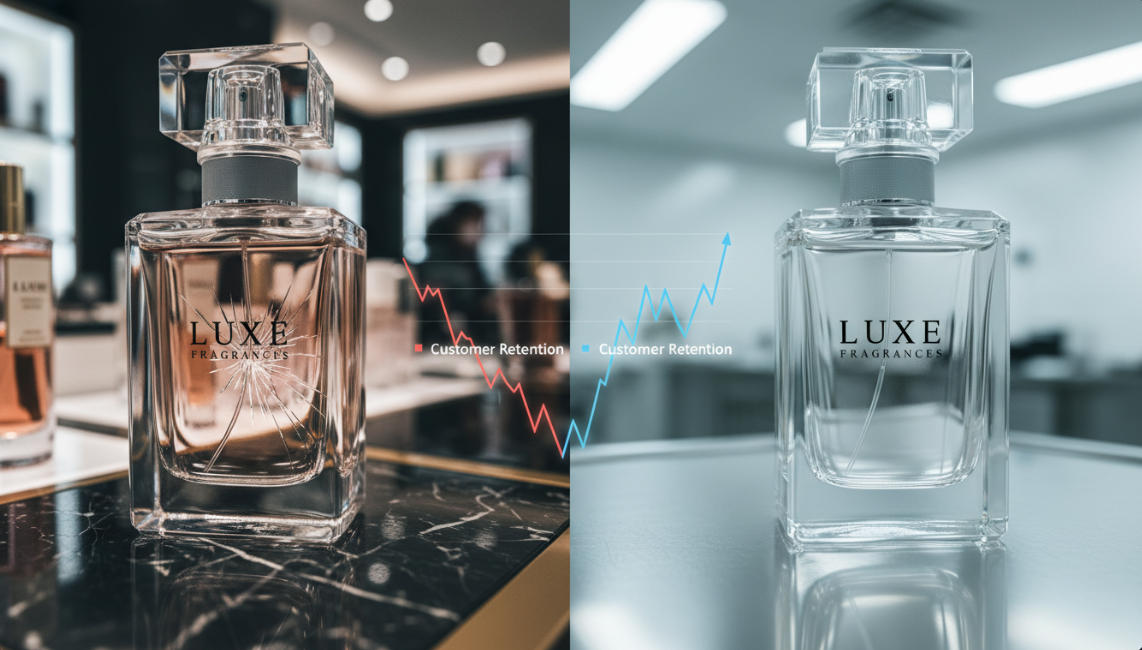
Most procurement conversations in the crystal perfume bottle wholesale market open with two questions: price per unit and minimum order quantity. These are rational starting points. But they are not the questions that determine whether a sourcing decision succeeds or fails in practice. The variable that drives the most significant downstream commercial outcomes — brand positioning, customer retention, return and complaint rates, and the total landed cost of your inventory — is product quality. And quality, in the context of natural crystal, is not a binary attribute that a product either has or does not have. It exists on a spectrum, it varies between batches, and it is determined by decisions made at every stage of the supply chain before the product reaches your hands.
The Commercial Cost of a Single Substandard Batch Is Rarely Captured in the Purchase Price
When a perfume bottle wholesale buyer receives a batch that does not meet the quality level agreed upon — whether because of internal fractures visible under retail lighting, inconsistent polish across a shipment, or stopper fit failures that cause leakage — the financial impact extends well beyond the unit cost of the defective product. A 2022 report by the Baymard Institute on e-commerce return rates documents that product quality failures generate return rates in premium consumer goods categories that frequently exceed 20% of sold units, and that customers who experience a quality-related return are statistically unlikely to repurchase from the same brand within a 12-month period.
For a fragrance brand or retailer that has built a mid-to-premium market position, a single compromised batch of crystal perfume bottles does not represent a one-time inventory loss. It represents a customer acquisition cost written off for every end consumer who received defective product. This means that your per-unit sourcing cost for crystal perfume bottles should always be evaluated against the full downstream cost of quality failure — not against the invoice value of the bottles themselves.
Natural Crystal Carries Material Variability That Synthetic Alternatives Do Not — and Your Brand Absorbs the Difference
Glass and synthetic resin perfume bottles are manufactured from homogeneous input materials under controlled industrial conditions. Natural crystal is not. As documented by the Gemological Institute of America (GIA), crystalline quartz minerals form under geological conditions that produce inherent internal variability — fracture systems, inclusion fields, and optical anisotropy that cannot be standardized out of the material regardless of how precise the downstream manufacturing process is. This is not a defect in natural crystal; it is a defining characteristic of the material. But it means that every crystal perfume factory working with genuine natural material is managing an input variable that its glass-bottle counterparts do not face.
The commercial implication for you as a buyer is direct: quality specification and grade-level verification are not optional steps that a cautious buyer adds to a standard procurement process. They are structural requirements of natural crystal sourcing that exist because the input material itself demands them. A perfume bottle manufacturer who does not offer grade-level disclosure is not simplifying your procurement process — they are removing the information you need to manage your own product quality risk. This means that sourcing natural crystal perfume bottles without grade specification is functionally equivalent to sourcing with an unmanaged quality variable built permanently into your supply chain.
Your End Customer’s Perception of Quality Is Set at the Moment They Handle the Bottle
In the fragrance and luxury personal care market, the packaging is not secondary to the product — it is a primary component of the product experience. Research published by the Journal of Consumer Psychology confirms that tactile and visual product attributes assessed within the first few seconds of physical contact significantly influence perceived product value, purchase intention, and post-purchase satisfaction. A crystal perfume bottle that displays visible internal fractures, surface polish inconsistencies, or dimensional irregularities communicates quality information to your end customer instantly — information that overrides the price point, the brand story, and the fragrance quality simultaneously.
The inverse is equally true. A natural crystal bottle that passes a rigorous quality standard — optically clear under retail lighting, uniformly polished to a reflective surface, dimensionally consistent with a cleanly seating stopper — communicates craftsmanship and material authenticity that no printed packaging claim can replicate. This means that the quality standard you set at the sourcing stage of your supply chain is the quality standard your end customer evaluates when they decide whether your brand deserves their repeat purchase.
The Long-Term Cost of Sourcing to Price Rather Than to Standard
Consider a scenario that recurs with predictable frequency in the crystal perfume bottle wholesale market. A buyer selects a supplier offering a unit price 18% below the market rate for the specified material and grade level. The first order — typically a smaller trial volume — arrives at acceptable quality, because small-volume orders often receive more focused production attention than large-volume replenishment orders. The second order, at three to four times the volume, arrives with a grade distribution that has shifted materially toward standard and low-grade product, without a corresponding adjustment to the invoice price.
At that point, you face a choice between absorbing the quality divergence to protect your launch timeline, returning the order and absorbing the logistics cost plus the timeline delay, or accepting the product and managing the downstream customer complaints that result from it. None of these options recovers the commercial position you held before the decision to prioritize per-unit price over documented quality specification. The International Trade Centre’s sourcing risk framework identifies price-quality misalignment as one of the primary causes of supply chain disruption in artisan and natural-material product categories — precisely because natural material sourcing requires quality documentation infrastructure that low-price suppliers consistently fail to maintain.
Selecting a perfume bottle manufacturer who can provide documented grade distribution, transparent material standards, and contractually specified quality thresholds does not eliminate the inherent variability of natural crystal. It ensures that the variability is managed systematically, disclosed accurately, and priced appropriately — giving you the information you need to build a supply relationship that serves your brand’s quality position over multiple order cycles, not just the first one.
What Actually Determines the Quality You Receive? The 4-Layer Quality Framework

The question most wholesale buyers ask when evaluating a perfume bottle manufacturer is: “Does this factory have good equipment and an experienced team?” The question you should be asking is more direct: “What does this factory consistently deliver to my warehouse — and can I verify it before I wire the payment?” There are four distinct layers of quality control that determine what you ultimately receive from any crystal perfume factory, and they are ranked below by the directness of their impact on your procurement outcomes.
Layer 1 — Final Quality Inspection: The Only Factor You Can Measure From Your Side of the Supply Chain
For most wholesale buyers, the first real moment of truth arrives when a shipment is opened and inspected on receipt. You were not present on the factory floor. You did not observe the raw stone being selected. You did not watch each bottle pass through the polishing station. What you have in front of you is the finished product — and that finished product must reflect, accurately and completely, every decision the manufacturer made at every upstream stage of production.
This is precisely why final quality inspection functions not merely as a last checkpoint in a production line, but as the measurable, verifiable result of everything that came before it. A perfume bottle manufacturer that invests in rigorous finished-goods inspection — sorting bottles systematically by optical transparency, surface finish consistency, structural integrity, and stopper fit tolerance — gives you a performance record that you can audit. According to quality management principles widely applied in precision manufacturing environments, inspection at the finished-goods stage is capable of identifying between 60% and 80% of defects that upstream process controls fail to catch. This means that the quality of a supplier’s inspection protocol is not a secondary consideration — it is the primary filter between their process failures and your inventory.
When you evaluate a perfume bottle wholesale supplier, request documented inspection records for at least one recent production batch, including the grade distribution breakdown and the rejection criteria applied. If a supplier cannot produce that documentation within 48 hours, that response alone tells you exactly how systematically they are tracking their own output quality.
Layer 2 — Raw Material Selection: The Hard Ceiling That No Manufacturing Process Can Break Through
No amount of manufacturing precision can produce a premium result from substandard input material. Natural crystal — primarily quartz-family minerals, including clear quartz, rose quartz, and smoky quartz — contains internal characteristics including fractures, inclusions, and color zoning that are invisible from the exterior of an uncut raw stone but become fully apparent inside a polished, finished bottle held up to light. According to the Gemological Institute of America (GIA), the internal characteristics of crystalline minerals form during crystal growth deep within geological formations and cannot be reversed or corrected through any post-extraction treatment or manufacturing process.
In practice, this geological reality means that a raw crystal block with the potential to yield premium-grade perfume bottles may only contribute usable material from less than 50% of its total volume. The remaining material — containing fracture networks, cloudy inclusion zones, or significant color banding — can only be allocated to standard or low-grade production, or discarded as waste. This is not a failure of manufacturing capability; it is a physical property of the material itself. However, it has a direct and measurable impact on the cost structure of any genuine crystal perfume bottle wholesale operation. If a supplier’s per-unit pricing does not reflect the cost of material selection waste at this stage, the question you need to answer is: where is that cost being hidden, and who is ultimately absorbing it?
The International Gem Society (IGS) documents that natural quartz clarity varies significantly even within a single crystal specimen extracted from the same deposit. This confirms that consistent premium output across a production run requires selective sourcing and material segregation at the raw stone stage — not merely careful processing of undifferentiated bulk material. This means that when you are comparing crystal perfume bottle wholesale pricing across multiple suppliers, a significantly lower price point almost always reflects a lower material selection standard, not a genuine efficiency advantage.
Layer 3 — Manufacturing Precision: Four Operational Principles That Separate Consistent Batches From Inconsistent Ones
Once premium raw material is identified, quarantined, and allocated to production, the manufacturing process determines how much of that material’s natural potential is actually realized in the finished bottle. A crystal perfume factory that operates without documented process controls will consistently fail to extract the full quality potential of its own input material — wasting both material cost and production capacity simultaneously.
The manufacturing principles that drive consistent, reproducible quality output across a high-volume production environment break down into four operational dimensions that any serious buyer should understand.
Precision in cutting means that each cut position is determined by mapping the internal fracture lines and inclusion clusters identified during material inspection — not by default geometry. Without this step, a bottle produced from premium-grade raw material can still display visible internal flaws simply because the cutting path intersected an avoidable fracture zone. Control in production means maintaining consistent parameters — spindle speed, feed rate, coolant temperature — across the full duration of each machining operation. Parameter drift during a production run increases micro-cracking rates at the machining stage in ways that only become visible after polishing, often after the batch has already passed initial inspection. Attention to dimensional detail means that every external specification — bottle profile geometry, neck diameter, base flatness, stopper fit tolerance — is verified on a per-unit basis at each stage, not estimated by sampling a percentage of each batch and extrapolating. And patience in polishing is operationally non-negotiable: the polishing stage of crystal perfume bottle production cannot be mechanically accelerated without producing visible surface degradation. An under-polished crystal surface scatters light inconsistently, creating a milky or dull visual effect that experienced buyers and end consumers identify immediately as lower-grade material.
These four principles are not a branding narrative. They describe the operational gap between a perfume bottle manufacturer that documents and monitors its own process at each stage, and one that monitors only its shipment volume. This means that when you conduct a factory audit or review a supplier’s production documentation, you should look for checkpoint records at each of these four stages — not just a single pass/fail record at the final inspection station.
Layer 4 — Supplier Integrity: The Hidden Risk Factor That Costs Wholesale Buyers More Than Any Other
The natural crystal and gemstone industry carries a well-documented history of material misrepresentation at multiple points in the supply chain. The Swiss Gemmological Institute SSEF publishes technical reports on gem identification and treatment disclosure, noting that undisclosed material treatments, composite substitutions, and origin misrepresentation remain persistent issues across the broader gemstone trade. The dynamics that produce these outcomes in the gemstone market apply with equal force — and frequently with less institutional oversight — to the crystal perfume bottle wholesale market.
What this means practically is that a perfume bottle manufacturer can possess genuine technical capability, operate modern equipment, and employ skilled workers, and still deliver inconsistent or misrepresented product if its commercial incentives are not structurally aligned with its stated quality commitments. The most common failure modes in this category follow recognizable patterns: batch product that diverges materially from approved pre-production samples, grade-level mixing within a single shipment without prior disclosure or adjusted pricing, and quality dispute resolution that consistently attributes problems to logistics, humidity, or customs handling rather than engaging with production root causes.
Supplier integrity is not a quality characteristic that can be assessed from a product catalog, a website, or a factory showroom visit. It becomes apparent in how a supplier responds when something goes wrong — and more revealingly, in whether they proactively disclose grade distribution, material sourcing, and batch-level quality data before you ask for it. This means that the most reliable way to assess a potential perfume bottle wholesale supplier’s integrity is to begin with a small trial order, request full documentation at every stage, and pay close attention to whether their communication becomes less precise as volume pressure increases.
Stone Elf Quality Data: What 600,000 Crystal Perfume Bottles Reveal About Real Manufacturing
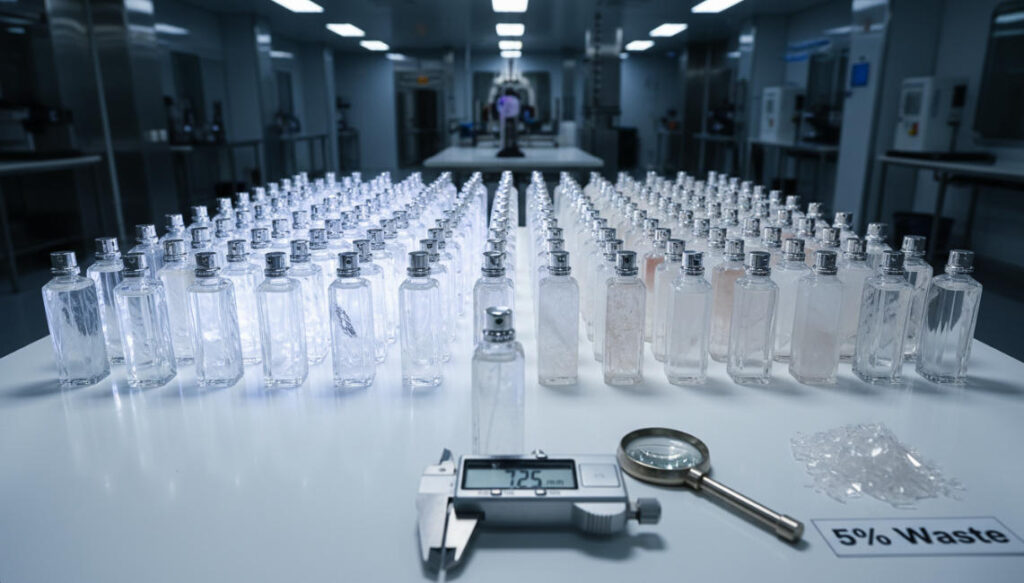
Production data disclosed by manufacturers in the crystal perfume bottle wholesale industry is rare — and when it does appear, it is almost always presented selectively to support a marketing argument rather than to give buyers a genuine picture of what manufacturing at scale actually looks like. The figures presented in this section come from Stone Elf’s 2025 full-year production records and are disclosed here in full, including the numbers that do not reflect favorably on any single marketing claim.
Breaking Down the 25% Premium Rate — What It Actually Takes to Reach Top Grade
Of approximately 600,000 natural crystal perfume bottles produced by Stone Elf in 2025, 25% were classified as premium grade upon completion of finished-goods inspection. This figure is not a ceiling that manufacturing improvements can easily push upward, because it is constrained primarily by raw material characteristics rather than by process variables. Premium-grade classification requires meeting concurrent thresholds across four measurable dimensions simultaneously.
The figures below are drawn directly from Stone Elf’s 2025 finished-goods inspection records and reflect actual grade outcomes across the full production year — not a curated sample.
Stone Elf 2025 Annual Production Quality Distribution · Total output: ~600,000 units
| Grade | Share | Est. units | Quality criteria | Recommended application |
|---|---|---|---|---|
| Premium | 25% | ~150,000 | Optically clear; zero visible fractures; uniform polish at 10× magnification; stopper fit within spec | High-end fragrance brands; luxury retail; gift collections |
| Standard | 60% | ~360,000 | Minor inclusions visible only under close direct light; commercially acceptable finish; functional seal | Mid-market fragrance; private label; wellness product lines |
| Low-grade | 10% | ~60,000 | Visible internal fractures or color banding; surface finish below commercial threshold | Promotional items; display samples; budget retail |
| Waste | 5% | ~30,000 | Structural failure, deep fracture propagation, or machining breakage; not shipped under any grade | Not applicable — discarded at final inspection |
| Total | 100% | ~600,000 | Full-year 2025 · Natural crystal quartz · Source-manufacturer verified data | |
Source: Stone Elf internal production records, 2025. Grade classification applied at finished-goods inspection stage. Waste rate reflects irreducible material variability inherent to natural crystal sourcing.
What this distribution reveals is not a quality problem — it is an honest accounting of what natural crystal manufacturing at maintained standards actually produces at scale.
Optical transparency is assessed under standardized lighting conditions, with any visible internal fracture or significant inclusion cluster constituting an automatic downgrade. Surface finish is evaluated at 10x magnification, with micro-scratches, polish haze, or surface waviness disqualifying a bottle from premium classification regardless of its optical clarity. Dimensional accuracy is verified against stopper fit specification, with seal integrity tested under functional conditions. Structural integrity is assessed through light transmission testing at the neck and base — the two zones where machining stress concentrations are highest and where micro-fracture initiation is most likely.
Achieving all four simultaneously, across a natural material that varies in its internal characteristics from specimen to specimen, is what constrains premium-grade output to 25% of production volume — not process inefficiency, and not a lack of investment in equipment. This means that if you are sourcing from a crystal perfume factory that claims a premium-grade rate substantially above 25% without a corresponding premium in raw material cost, you are either working with a supplier that applies less stringent grading criteria than the ones described above, or one that is not being transparent about how it classifies its own output.
The 60% Standard Grade — Why It Represents the Realistic Baseline for Most Commercial Applications
Standard-grade output accounted for 60% of Stone Elf’s 2025 production volume, making it the dominant output category by a significant margin. Standard-grade bottles meet the functional and aesthetic requirements for the majority of commercial applications in the perfume bottle wholesale market. Bottles in this category may contain minor internal features — small inclusions visible only under direct close-range lighting, or a surface polish that is commercially acceptable but falls short of the reflective consistency achieved in premium-grade product.
For buyers sourcing crystal perfume bottle wholesale for mid-market fragrance brands, promotional gift collections, private label projects at accessible retail price points, or wellness product lines where natural character is positioned as a design feature rather than a defect, standard-grade material represents the commercially appropriate choice — provided the grade level is disclosed clearly and priced to reflect it accurately. The commercial damage in this market does not come from standard-grade product existing; it comes from standard-grade product being shipped under premium-grade pricing or without any grade classification disclosure at all.
Transparent grade separation between premium and standard product is not a service feature that a responsible perfume bottle manufacturer offers as an optional add-on. It is the minimum standard of commercial transparency that you should expect as a baseline from any supplier before you place a purchase order.
Understanding the 5% Defect Rate — And What It Signals About Material Authenticity
Approximately 5% of Stone Elf’s 2025 production was classified as unusable and was not shipped under any product grade classification. This waste rate is a structural consequence of maintaining natural crystal material standards at the input stage without substituting composite, synthetic, or treated material to reduce raw-material rejection rates.
Natural quartz, as documented by gemological references including the GIA Gem Encyclopedia, does not occur in perfectly homogeneous, inclusion-free form across commercially available raw material volumes. Fracture systems and inclusion fields are geologically normal features of crystalline silica minerals formed under natural conditions. A perfume bottle manufacturer that reports zero waste or near-zero waste in natural crystal production — without a corresponding premium in raw material cost — is making a claim that is inconsistent with the documented physical properties of the material it claims to be using.
A disclosed 5% waste rate from a crystal perfume factory is not evidence of process inefficiency. It is evidence that the supplier is working with genuine natural crystal material and maintaining quality standards rigorous enough to reject output that does not meet them. Buyers who apply pressure for zero-waste pricing on natural crystal orders are, whether they intend to or not, creating a commercial incentive for their supplier to substitute composite or synthetic material without disclosure. The cost of that substitution does not disappear — it transfers to your end customer’s perception of your product.
How to Evaluate a Crystal Perfume Bottle Manufacturer Before You Place Your First Order

Selecting a perfume bottle manufacturer for a wholesale supply relationship is a procurement decision with compounding consequences. A supplier whose quality is inconsistent at low order volumes will not become more consistent as your order volumes increase — the process problems that produce inconsistent output at small scale become structural supply chain liabilities at large scale. The evaluation framework below is designed to give you actionable information before you commit, not after you have already experienced a batch quality problem.
Five Verification Questions That Reveal How a Supplier Actually Operates
There are five questions that will give you more accurate information about a crystal perfume factory’s actual quality system than any factory tour, product video, or certification document displayed on a website. These are not negotiation tactics — they are standard due-diligence questions that any professional procurement process should include before entering a supply relationship with a perfume bottle wholesale vendor.
Question one: Can you provide documented grade distribution data from a recent production batch — specifically, the percentage breakdown across premium, standard, low-grade, and waste classifications, with the grading criteria applied at each level? A supplier who tracks this data systematically can produce it within 24 to 48 hours. A supplier who cannot produce it is telling you that their quality outcomes are not being measured in a way that would allow them to guarantee consistency.
Question two: What process controls prevent the sample-to-batch quality gap — the divergence between the samples you approved and the product that ships at full volume? This is the single most frequently reported quality problem in crystal perfume bottle wholesale sourcing, and a supplier who does not have a documented answer to this question has not solved the problem.
Question three: Where is your raw crystal material sourced, and what are the known inclusion and fracture characteristics associated with that source region? A supplier with genuine control over their raw material procurement will be able to answer this question specifically. A supplier who deflects to generalities — “we source only the best quality material” — is signaling that their sourcing process is not systematically managed.
Question four: How are premium-grade and standard-grade products priced differently in your wholesale structure, and can a grade minimum be specified as a contractual term in the purchase order? If a supplier cannot price grade levels separately, they are not differentiating them in production — which means you cannot reliably source the grade level your product requires.
Question five: What is your documented resolution process when delivered product does not meet the agreed quality specification? Request the written policy, not the verbal assurance. The terms a supplier is willing to commit to in writing reflect their actual confidence in their own production consistency.
These five questions are not a complete supplier qualification process, but they will efficiently surface the information that matters most for your sourcing decision. A perfume bottle manufacturer that can answer all five with specific, documented responses has demonstrated a level of process maturity that generic product catalogs cannot communicate.
Red Flags That Reliably Predict Quality Problems Before the First Shipment Arrives
Certain supplier behaviors, observable before any product is delivered, correlate strongly with downstream quality problems. Recognizing them early can protect your procurement outcomes without requiring you to wait for a failed batch to identify a problematic supplier.
A per-unit price that is materially below the market rate for genuine natural crystal of the disclosed quality level is the most frequently encountered red flag in the perfume bottle wholesale market. As established in the raw material section above, natural crystal manufacturing at maintained quality standards carries an irreducible waste cost. Pricing that does not account for that cost is not evidence of operational efficiency — it is evidence of either a lower material standard or a margin structure that will create pressure to cut corners at a point in the relationship when your switching costs are higher.
Reluctance or inability to provide batch-level quality documentation — grade distribution records, inspection criteria, rejection logs — is a reliable signal that such documentation does not exist in any systematic form. Without systematic documentation, quality outcomes cannot be tracked, analyzed, or guaranteed with any consistency. A crystal perfume factory that does not measure its own quality performance cannot control it.
The pattern of exceptionally refined sample presentation combined with urgency to commit before you have completed your own verification process is a sequencing problem that has cost wholesale buyers significant losses. Samples represent the best a supplier can produce under focused attention; they do not automatically represent what a full production run under commercial time pressure will deliver. Any perfume bottle manufacturer that resists giving you time to conduct independent verification before committing to volume should be approached with significant caution.
Finally, a supplier who consistently attributes delivered quality problems to shipping conditions, customs handling, or seasonal humidity — rather than engaging with the production variables that actually determine quality outcomes — is a supplier whose problems will repeat. Logistics can crack a poorly manufactured bottle. Logistics cannot create the internal fractures and surface finish deficiencies that characterize under-standard product.
Stone Elf — Ten Years of Natural Crystal Perfume Bottle Manufacturing Built on Measurable Standards
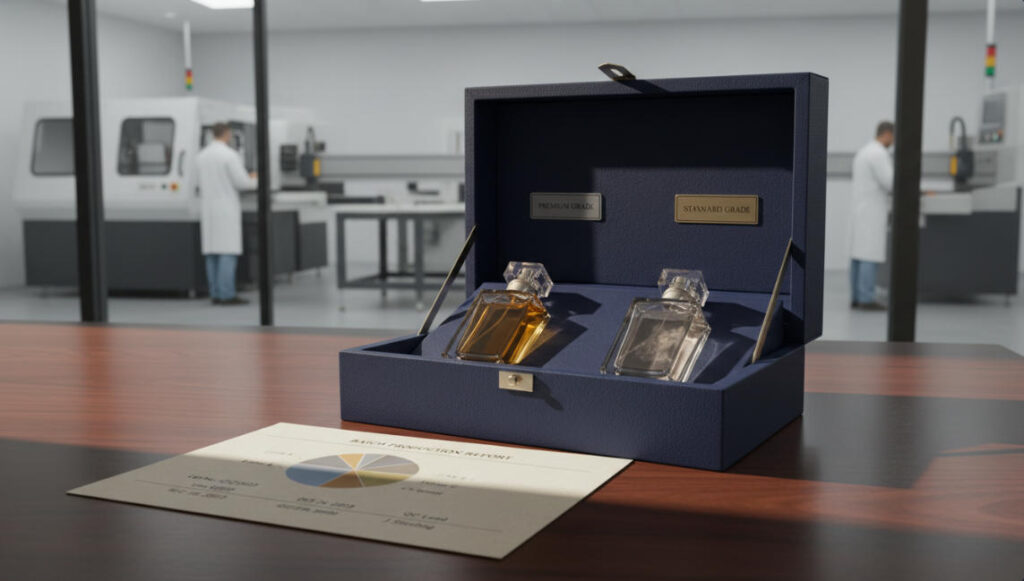
From Raw Stone to Finished Bottle: A Manufacturing Record, Not a Marketing Narrative
Stone Elf has operated as a source manufacturer of natural crystal perfume bottles for over ten years, maintaining direct operational control over the complete production process — from raw material procurement and initial stone selection through machining, polishing, finished-goods inspection, and grade-segregated shipment preparation. The manufacturing approach applied throughout this period is not built around equipment lists or facility scale claims. It is built around the four operational principles described in Section 1 of this article — precision in cutting, control in process parameters, attention to dimensional detail, and patience in the polishing stage — applied consistently across a production volume that reached approximately 600,000 units in 2025.
The full production data for that year — 25% premium grade, 60% standard grade, 10% low grade, 5% waste — is disclosed in this article because Stone Elf’s position is that transparency in grade distribution is a prerequisite for any productive supply relationship in the crystal perfume bottle wholesale market. If you are currently evaluating perfume bottle wholesale suppliers and you want to understand what you are actually sourcing, you deserve access to real production numbers before you place an order, not after a quality dispute has already begun.
The geological constraints that make premium natural crystal scarce — the fracture systems, inclusion fields, and color zoning documented by institutions including the GIA and the IGS — apply equally to every supplier in this market. The difference between suppliers lies in whether those constraints are managed transparently, with grade-level pricing and documentation that reflects actual production outcomes, or obscured behind undifferentiated bulk pricing that transfers the cost of material variability to the buyer without disclosing it.
Stone Elf’s production history of over ten years has produced the material sourcing relationships, the process documentation, and the quality inspection infrastructure necessary to consistently allocate premium-grade product to buyers who specify and pay for it — and to offer standard-grade product at pricing that reflects its actual production cost for buyers for whom it is the commercially appropriate choice. Grade mixing without grade disclosure is not a practice applied in Stone Elf’s production or shipping operations, because it is not a practice that produces durable supply relationships for either party.
How to Begin a Sourcing Evaluation with Stone Elf as Your Crystal Perfume Factory Partner
If you are ready to evaluate Stone Elf as a perfume bottle manufacturer for your next project, the practical starting point is a sample request that includes a grade specification. You can specify whether your product line requires the premium 25% — for positioning at the upper end of your retail channel — or whether standard-grade material at its corresponding price point is the appropriate fit for your application. Stone Elf provides batch production data alongside any sample shipment so that you can verify grade consistency before committing to full-volume production.
You can also request a wholesale pricing structure that reflects the grade distribution applicable to your specific order parameters, so that any cost comparison you conduct against other crystal perfume bottle wholesale suppliers is made on a genuinely comparable basis — same material grade, same specification, same documentation standard. Comparing an undocumented bulk price against a grade-specific documented price is not a valid comparison, and it is the comparison structure that allows lower-standard suppliers to appear price-competitive in initial sourcing evaluations.
The objective of this evaluation process is not to move quickly toward a transaction. It is to determine whether Stone Elf’s production capability, material standards, and operational transparency match what your sourcing requirements actually demand. If they do, the supply relationship that follows will be productive and built on a shared understanding of what is being produced, at what quality level, and at what price. If they do not, the evaluation process will have given you a clearer and more accurate specification of what you need — which will make your search for the right perfume bottle manufacturer more efficient regardless of outcome.
Natural crystal is a finite, variable material. The quality that reaches your warehouse is the result of every decision made between the moment a raw stone is selected and the moment a finished bottle is packed for shipment. Understanding that supply chain — and choosing a supplier who can account for every stage of it with documented evidence rather than commercial assurances — is the most consequential sourcing decision you will make in this product category.
Faqs about Crystal Perume Bottle Manufacturer Quality Ensure
1. What percentage of natural crystal perfume bottles actually reach premium grade?
Based on Stone Elf’s 2025 production data covering 600,000 units, only 25% qualify as premium grade. The remaining output is classified as standard (60%), low-grade (10%), or unusable waste (5%) — a distribution that reflects the inherent variability of natural crystal raw material.
2. Why does natural crystal perfume bottle quality vary between batches?
Natural crystal forms under geological conditions that produce internal fractures, inclusions, and color variation that cannot be standardized out of the material. Even within a single raw stone, less than 50% of the volume typically yields premium-grade output, making batch-to-batch consistency a function of raw material selection discipline rather than manufacturing equipment alone.
3. How do I verify a crystal perfume bottle manufacturer’s quality before placing a wholesale order?
Request documented grade distribution data from a recent production batch, ask how sample quality is maintained at full production volume, and confirm whether premium and standard grades are priced and shipped separately. A supplier who cannot produce batch-level inspection records within 48 hours is unlikely to be tracking quality outcomes systematically.
4. What is a realistic waste rate for genuine natural crystal perfume bottle production?
Approximately 5% waste is structurally normal for a manufacturer working with genuine natural crystal at maintained quality standards. A supplier reporting near-zero waste without a corresponding premium in raw material cost is likely either applying looser grading criteria or substituting composite and synthetic material without disclosure.
5. What is the difference between premium-grade and standard-grade crystal perfume bottles?
Premium-grade bottles are optically clear under direct lighting with zero visible internal fractures, a uniformly reflective surface finish verified at 10× magnification, and a stopper fit within dimensional specification. Standard-grade bottles meet functional and commercial requirements but may contain minor inclusions visible under close direct light and a surface finish that falls short of premium reflectivity — making them suitable for mid-market applications rather than high-end retail positioning.
